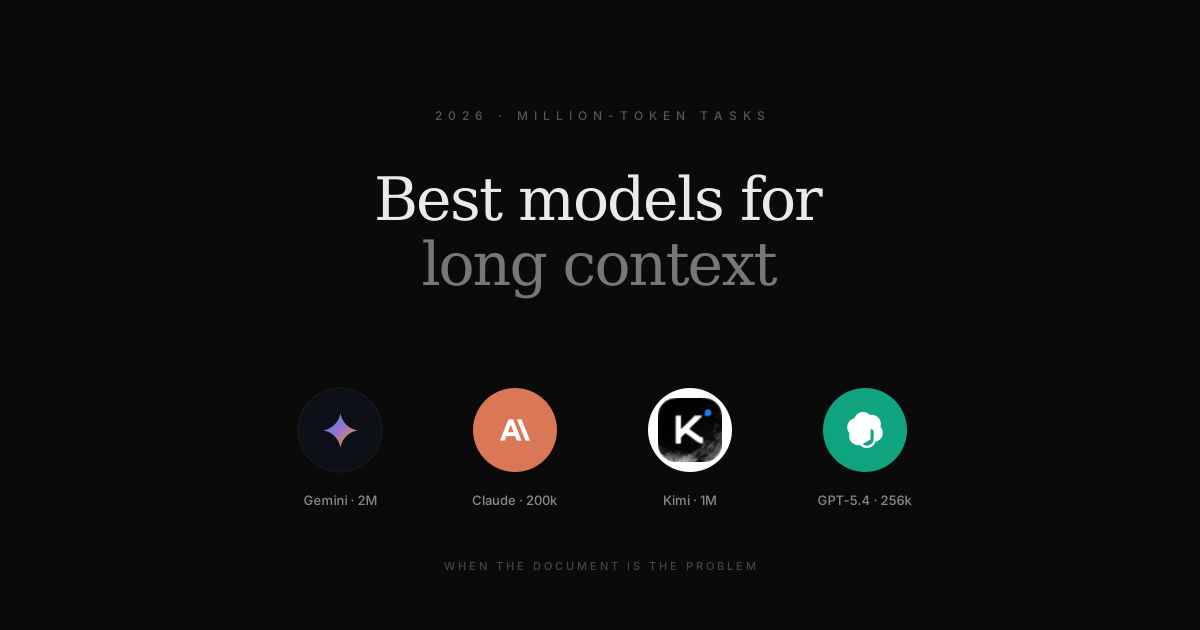
"Context window" is the max number of tokens a model can read in a single prompt. In 2024 that was 128k on a good day. In 2026 it's 200k (Claude), 256k (GPT-5), 1M (Kimi), 2M (Gemini). But raw context window isn't the whole story — models differ wildly in how well they actually use the full context. Here's the real-world comparison.
The long-context leaderboard
| Model | Context window | Effective use | Price/M input | Good for |
|---|---|---|---|---|
| Gemini 3.1 Pro | 2,000,000 | Strong end-to-end | $1.25 | Books, codebases, research |
| Kimi K2.5 | 1,000,000 | Solid to ~800k | $0.30 | Cheap long-doc QA |
| GPT-5.4 xhigh | 256,000 | Degrades past ~180k | $1.25 | Long docs that fit |
| Claude Opus 4.7 | 200,000 | Degrades past ~150k | $3.00 | Reasoning on long inputs |
| Claude Sonnet 4.6 | 200,000 | Solid to 150k | $1.00 | Cheaper long-doc work |
| Qwen3.6 Plus | 128,000 | Solid | $0.35 | Moderate-length docs |
"Effective use" is what matters — the context window size is marketing; real recall across the full window is the benchmark.
Gemini 3.1 Pro — the only true 2M model
Gemini's 2M context is the only frontier context window that actually works end-to-end. You can feed it a 1,500-page PDF, an entire codebase, a book — and it reasons over the full thing without the quality degradation you see in competitors past their "nominal" limits.
Real-world tests:
- Feed a 1.5M-token codebase, ask "where do we handle rate limits across all services?" — finds every occurrence
- Load 50 research papers, ask "which methodology is most common?" — accurate synthesis
- Full season of meeting transcripts, ask "what decisions were made about X?" — tracks across months
The catch: inference on large context is slow and expensive. A 1M-token prompt takes 30-60 seconds to process. Cost scales linearly with input length.
Use Gemini 3.1 Pro long-context for:
- Codebase Q&A
- Legal document review
- Research synthesis across many sources
- Customer history analysis (e.g., "what has this user asked in the past 2 years?")
- Any task where the document size IS the problem
Kimi K2.5 — the cheap long-context play
Moonshot's Kimi K2.5 is the budget long-context model. 1M tokens of context at $0.30/M input — about a quarter of Gemini's price. Intelligence Index 47 (vs Gemini's 57), so it's behind on hardest reasoning, but for straightforward long-doc tasks (find, summarize, extract) it's an excellent value pick.
Where it wins:
- Bulk document processing (summarize 1,000 PDFs)
- RAG backup when Gemini is overloaded
- Chinese-language long documents (Kimi is Chinese-first)
- Startups doing long-context work on a budget
Where it loses:
- Complex reasoning over long context (Gemini wins)
- Creative synthesis (Gemini wins)
- Western-language edge cases
Claude Opus 4.7 — reasoning, limited window
Claude's 200k context is not huge by 2026 standards, but the quality of reasoning over what fits is unmatched. For tasks where you need deep thinking over a ~100k-token corpus, Opus beats Gemini on output quality even with a smaller window.
Good for:
- Legal memo drafting with supporting docs
- Research-style writing with cited sources
- Book chapter or paper analysis (single work at a time)
- Complex multi-step reasoning where the full input fits
Bad for:
- Anything genuinely bigger than 150k tokens
GPT-5.4 xhigh — middle ground
256k context, good quality. Handles long docs reasonably well but degrades past ~180k in real-world tests. For doc sizes in the 100-200k range, GPT-5.4 is a solid default — cheaper than Opus, similar quality, slightly larger window.
The "needle in haystack" fallacy
Most long-context benchmarks use "needle in haystack" tests — hide a fact in a long document and see if the model finds it. Every frontier model scores >95% on these now. But real long-context tasks are harder:
- Multi-hop reasoning ("who wrote the section that references document X?")
- Quantitative aggregation ("how many companies mentioned ARR in their last report?")
- Style-consistent synthesis ("summarize these 50 papers in a consistent academic voice")
On these, models still diverge significantly. Gemini 3.1 Pro is the clear leader for 500k+ context tasks. Claude Opus wins for ≤150k reasoning depth. Kimi is cheap and surprisingly competent for bulk extraction.
Long context vs RAG
Two approaches to long documents:
Long context: feed the whole doc to the model. Pros: no retrieval errors, full context available. Cons: expensive, slow, capped at model's window.
RAG (retrieval-augmented generation): chunk the doc, embed chunks, retrieve only relevant ones, feed a small context. Pros: cheap, fast, unlimited doc size. Cons: retrieval can miss relevant content, synthesis is worse.
In 2026, the practical rule:
- <100k tokens → just feed it (any model)
- 100k-1M → long context (Gemini, Kimi) usually beats RAG
- 1M-10M → hybrid (Gemini with summarization, or RAG with large chunks)
- 10M+ → RAG-only
How Klaws handles long context
For tasks that involve long documents, Klaws routes to Gemini 3.1 Pro automatically when the input exceeds ~100k tokens. For shorter docs, routing stays on Sonnet or cheaper models. You don't configure this — the system detects the context size and picks the right model.
For users doing massive document work (thousands of PDFs, full codebases, legal archives), the Pro and Ultra plans include the necessary credit budget. See pricing →
The honest verdict
Gemini 3.1 Pro is the answer for 90% of serious long-context work in 2026. Nothing else comes close on effective 500k+ token use.
Kimi K2.5 is the budget answer for bulk long-doc processing where you don't need frontier reasoning.
Claude Opus 4.7 is still best for deep reasoning on documents that fit in 200k. If your corpus is smaller but complex, Opus wins.
Everyone else is playing catch-up.
See also: Gemini 3 vs Claude Opus, best AI models 2026, best AI models for coding.