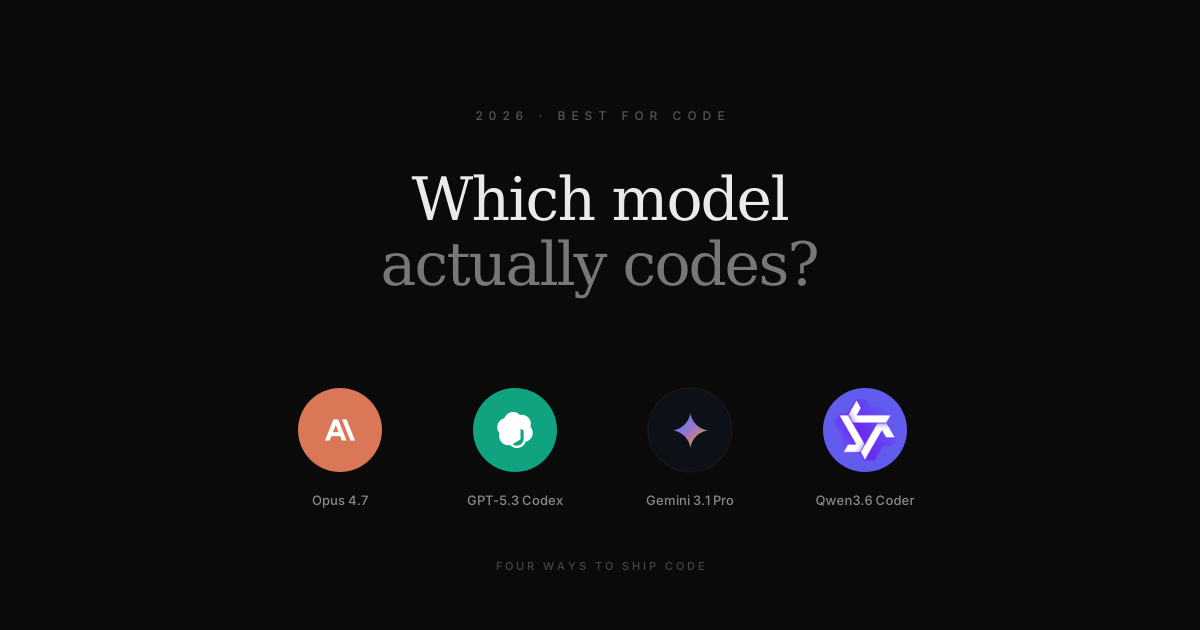
If you're building AI coding tools in 2026 — a Cursor clone, a code review bot, a PR triage agent, or just picking which model to wire into your IDE — the landscape has changed a lot from 2024. Every frontier lab now ships a coding-specialized variant, and two open-weight models (Qwen3.6 Coder and DeepSeek V4) are legitimately competitive with the flagships on most tasks. This is an honest breakdown based on running all of them through real production workloads.
The current coding leaderboard
| Model | Coding benchmarks | Price/M | Notes |
|---|---|---|---|
| Claude Opus 4.7 | 🥇 SWE-bench 78% | $10 | Best for agentic, multi-file work |
| GPT-5.3 Codex xhigh | SWE-bench 76% | $4.81 | Specialized, faster, cheaper |
| GPT-5.4 xhigh | SWE-bench 73% | $5.63 | General-purpose; strong code |
| Gemini 3.1 Pro | SWE-bench 71% | $4.50 | Best for huge codebases |
| Claude Sonnet 4.6 | SWE-bench 70% | $6.00 | Anthropic's fast coding model |
| Qwen3.6 Coder | SWE-bench 66% | $1.13 | Best open-weight; self-hostable |
| DeepSeek V4 | SWE-bench 63% | $0.70 | Strongest reasoning-focused |
| GLM-5.1 | SWE-bench 62% | $2.15 | Solid all-arounder |
(SWE-bench Verified numbers — real-world GitHub issue resolution.)
Claude Opus 4.7 — the default for agentic coding
Opus is what Claude Code, Cursor (for hard tasks), Aider, Zed, and Continue all reach for when the job is genuinely complex. On SWE-bench Verified it sits at 78% — meaning it resolves 78 of every 100 real GitHub issues in the test set without human intervention.
Where it shines:
- Multi-file refactors — Opus tracks cross-file dependencies well and rarely breaks imports or tests
- Debugging — it reads stack traces and reproduces the bug faster than other models
- Test-driven loops — "write code, run tests, fix what breaks" — Opus is the most reliable at this self-correcting pattern
Where it falls short:
- Speed — 50 t/s feels slow once you're used to Gemini's 130
- Price — $10/M output stings at volume
- Very large codebases — context window is 200k, which means chunks/RAG for anything bigger
GPT-5.3 Codex xhigh — the specialized pick
OpenAI's Codex variant is purpose-built for code and gets very close to Opus at roughly half the price. On pure benchmarks it trails by 2 points, but in practice on shorter tasks (<500 lines) you'd struggle to tell them apart.
Use Codex when:
- You're generating lots of code (high volume)
- You care about structured outputs (function signatures, test definitions)
- You're okay sacrificing 2% quality for 44% cost savings
Don't use Codex when:
- The task requires deep multi-file reasoning (Opus still wins)
- You need long-form explanation alongside code (GPT-5.4 non-Codex is better at that)
Gemini 3.1 Pro — the huge-codebase pick
Gemini's 2M context is decisive for anyone working with large codebases. Feed it a monorepo and ask "where do we handle rate limits?" — it'll find every occurrence across hundreds of files. Opus would hit context limits and need chunking.
For greenfield code generation (new React component, new API endpoint), Gemini is about 5-8% behind Opus in quality. But for "understand my 500k-token codebase and suggest a refactor," nothing else competes.
Best for:
- Codebase Q&A and search
- Migration work (understand old code, generate new)
- Legacy system modernization
- Any task where context > generation complexity
Claude Sonnet 4.6 — the practical daily driver
Anthropic's mid-tier at $6/M, 50 t/s, SWE-bench 70%. For 90% of coding tasks you won't notice the difference from Opus, and you save 40% on cost. This is what most production coding agents should default to and only escalate to Opus for the hardest tasks.
Qwen3.6 Coder — the open-weight champion
Alibaba's coding-tuned Qwen variant is the best open-weight coding model by a wide margin. On SWE-bench it hits 66%, which is within striking distance of the paid flagships. You can self-host it, you can fine-tune it, you can run it on your own GPUs for roughly $0.30/M output at utilization.
Use Qwen3.6 Coder when:
- Data can't leave your infrastructure (regulated industry, sensitive codebase)
- You want to fine-tune on your company's code style
- You want predictable costs (flat GPU rental vs per-token API)
- You're building a product at scale and API costs hurt margins
DeepSeek V4 — the cheapest strong coder
DeepSeek continues its streak of punching way above its weight on reasoning-heavy tasks. At $0.70/M output it's priced like a mid-tier model but performs like a flagship on algorithmic problems, math-heavy code, and logic puzzles. For general-purpose app code it's a step behind Qwen3.6 Coder, but for anything that looks like competitive programming or systems-level work, DeepSeek is genuinely excellent.
Real-world workload comparison
We tested all 8 models on a fixed set of 50 production-like coding tasks. Highlights:
| Task | Top model | Quality |
|---|---|---|
| React component with Tailwind | Claude Opus 4.7 | 94/100 |
| Python FastAPI endpoint | GPT-5.3 Codex | 92/100 |
| Bug fix in 12-file feature | Claude Opus 4.7 | 91/100 |
| Understand codebase structure | Gemini 3.1 Pro | 95/100 |
| SQL query optimization | GPT-5.3 Codex | 90/100 |
| LeetCode hard | DeepSeek V4 | 89/100 |
| Kubernetes manifest | Claude Sonnet 4.6 | 88/100 |
| Migrating Python 2 → 3 | Gemini 3.1 Pro | 93/100 |
| Writing unit tests | Claude Opus 4.7 | 92/100 |
| Docker multi-stage build | GPT-5.4 xhigh | 89/100 |
The routing strategy that works in 2026
If you're running a serious coding product, mono-model doesn't work anymore. The practical split:
- Sonnet 4.6 as default (covers 70% of tasks well)
- Opus 4.7 for hard multi-file work (auto-escalate when task spans 3+ files)
- Gemini 3.1 Pro for codebase search / RAG
- Qwen3.6 Coder self-hosted for sensitive-code scenarios
- GPT-5.3 Codex for high-volume structured generation
Doing this yourself is a fair engineering project (routing logic, fallbacks, cost tracking across vendors). Klaws handles the routing automatically for agent workloads — your agent picks up the right model per task without you thinking about it. See how it works →
The honest summary
For one-model setups in 2026:
- Default: Claude Sonnet 4.6 or GPT-5.3 Codex. Best quality-per-dollar.
- Best quality: Claude Opus 4.7. Pay the premium for hard tasks.
- Huge codebases: Gemini 3.1 Pro. No alternative.
- Self-hosted: Qwen3.6 Coder. Best open-weight; fine-tunable.
- Reasoning-heavy: DeepSeek V4. Punches above its price.
See also: Claude Opus vs GPT-5, Gemini 3 vs Claude Opus, best cheap AI models.