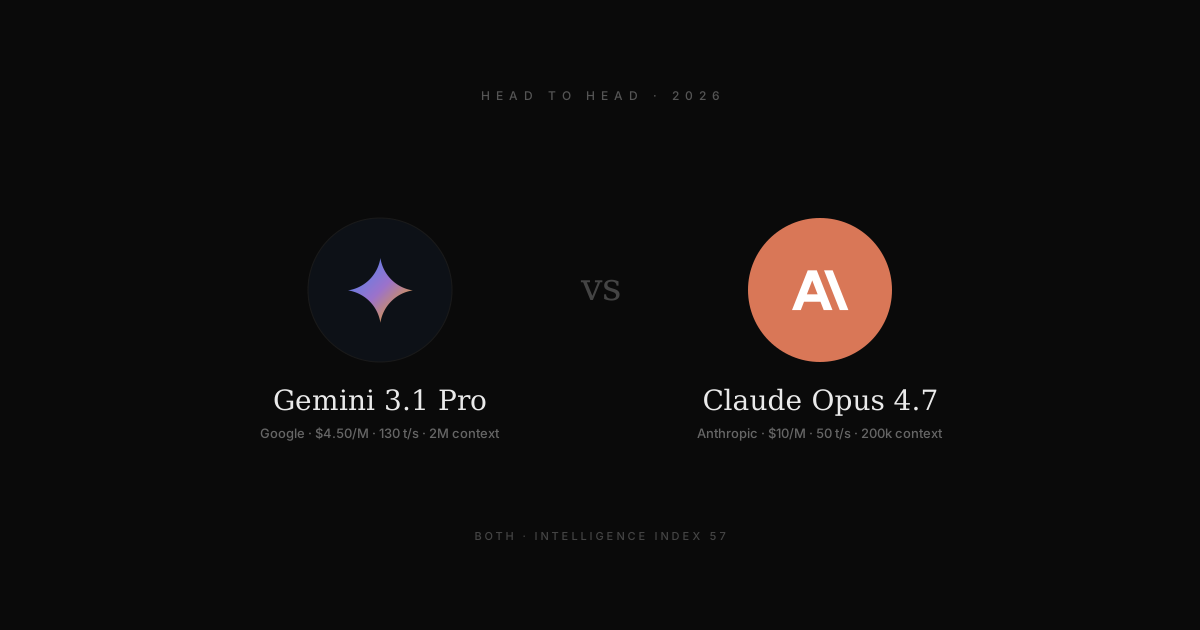
Google's Gemini 3.1 Pro Preview just tied Claude Opus 4.7 at Intelligence Index 57 on the 2026 leaderboard. On every other axis that matters, Gemini wins: 2.6x faster, 2.2x cheaper, 10x the context window. That makes this the most interesting head-to-head of 2026 — and the one where the answer depends heavily on what you do with it.
For most tasks, Gemini is the better pick now. For specific kinds of work, Claude Opus is still worth the premium. Below we break down exactly which is which, and give you a decision framework you can apply to your own work.
The raw stats
| Gemini 3.1 Pro | Claude Opus 4.7 | |
|---|---|---|
| Intelligence Index | 57 | 57 |
| Speed | 130 t/s | 50 t/s |
| Price (output per 1M) | $4.50 | $10.00 |
| Price (input per 1M) | $1.25 | $3.00 |
| Context window | 2,000,000 | 200,000 |
| Modalities | Text + image + audio + video | Text + image |
| Best for | Long docs, speed, value | Writing, coding, nuance |
| Provider | Anthropic |
If Gemini matched Opus in every quality dimension, this article would be over. But it doesn't.
Where Gemini 3.1 Pro wins (decisively)
Long documents. The 2-million-token context is not a marketing number. Gemini 3.1 genuinely uses the full context — you can feed it a 1,500-page PDF and ask questions about page 800. Claude Opus starts degrading past ~150k tokens in our testing. For anyone working with books, research corpora, large codebases, or long legal documents, there is no alternative.
Concretely: feed Gemini a 1.5M-token codebase and ask "which functions call ExportData?" — it'll find all of them. Feed Opus the same and you'll hit the context limit, have to chunk, lose cross-references, and get partial answers.
Price-sensitive production. At $4.50/M output vs $10.00/M, Gemini is 55% cheaper. For any app doing more than 5M tokens/month, this is decisive. At 100M tokens/month, the yearly difference is roughly $6,600 — enough to fund a side project on its own.
Latency-sensitive UX. 130 tokens/second makes Gemini feel snappy in chat UIs. Opus at 50 t/s feels slow on anything longer than a paragraph. For live assistants, voice mode, or anything the user is watching stream, Gemini's speed advantage is visceral.
Multilingual. Gemini has broader and deeper multilingual performance. If you're building something for non-English markets — especially Asian languages (Chinese, Japanese, Korean, Thai), Arabic, or Hindi — Gemini is usually the better pick. Anthropic's Claude is improving but was trained predominantly on English.
Vision + video. Gemini 3.1 handles image, video, and audio inputs natively. Claude Opus does images well but doesn't match Gemini's video understanding. If your product involves analyzing videos, transcribing and reasoning over audio, or handling mixed-media inputs, Gemini is the only frontier option.
Cost of input tokens. Gemini's $1.25/M input cost (vs Opus's $3/M) makes a huge difference for RAG workloads where you feed large documents on every call. A typical RAG app with 50k input tokens per call costs ~$0.06 per call on Gemini vs $0.15 on Opus — 2.4x cheaper per query before you even consider output costs.
Tool use and agent workflows. Gemini 3.1 has caught up significantly on tool use. It's now competitive with Opus for multi-step agent tasks, though Opus still has a slight edge on complex orchestration.
Google ecosystem integration. If you're already in GCP, Vertex AI, or using Google Workspace, Gemini's integrations are tighter. Native integration with Google Search, Drive, Gmail, and Workspace apps is a significant quality-of-life advantage.
Where Claude Opus 4.7 still wins
Nuanced writing. Opus still has the edge in "human-sounding" prose. Gemini writes correctly; Opus writes well. For marketing copy, essays, thought leadership, creative writing, and anywhere voice matters, Opus produces less polished but more alive text.
Test this yourself: give both models a prompt like "write a 500-word essay about the value of boredom." Opus's version will feel like it was written by a thoughtful human. Gemini's version will be correct, well-structured, and slightly soulless.
Agentic coding. Claude Opus remains the default for AI coding tools — Claude Code, Cursor, Aider, Zed, Continue all default to Opus for hard tasks. Gemini has closed the gap but isn't quite there on multi-step code refactors. Opus handles "edit these 8 files, update the tests, run them, fix what breaks" with less supervision.
Instruction following. Opus follows complex instructions more precisely. If you're giving it a 20-constraint prompt, it respects all 20 more reliably. Gemini occasionally drops or softens constraints.
Safety calibration. For enterprise use, Anthropic's safety posture is more mature. Gemini occasionally refuses benign requests due to over-aggressive filters — a known issue Google has been working on but hasn't fully solved.
Consistency across conversations. In long back-and-forth conversations (50+ turns), Opus stays more coherent. Gemini sometimes re-interprets context in ways that break continuity.
Enterprise trust. Many compliance-conscious enterprises still default to Anthropic because of its published safety research, constitutional AI approach, and well-documented deployment guidelines. Google Cloud is also trusted, but Anthropic's AI-safety-first positioning appeals to some buyers.
Real-world task comparison
Based on thousands of real prompts we've run across both models:
| Task | Better choice | Why |
|---|---|---|
| Summarize a 100k-token document | Gemini 3.1 Pro | Context handling; faster |
| Summarize a 2M-token codebase | Gemini 3.1 Pro | Only one that can |
| Write a marketing landing page | Claude Opus | Better voice |
| Refactor a React component | Tie | Both excellent |
| Refactor a 20-file feature | Claude Opus | Cross-file reasoning |
| Extract structured data from PDFs | Gemini 3.1 Pro | Faster, cheaper, same quality |
| Translate to Japanese | Gemini 3.1 Pro | Multilingual edge |
| Write a research brief | Claude Opus | Nuanced synthesis |
| Analyze a video | Gemini 3.1 Pro | Native video support |
| Answer technical legal questions | Claude Opus | Instruction following |
| Power a chat UI | Gemini 3.1 Pro | Speed matters |
| Generate a SaaS dashboard | Tie | Both strong |
| High-volume customer support | Gemini 3.1 Pro | Price + speed |
| Deep creative writing | Claude Opus | Voice and nuance |
The price math over time
Running 10M tokens/month (a small production app):
- Gemini 3.1 Pro: ~$45/month
- Claude Opus 4.7: ~$100/month
- Difference: ~$660/year
Running 100M tokens/month (medium app):
- Gemini 3.1 Pro: ~$450/month
- Claude Opus 4.7: ~$1,000/month
- Difference: ~$6,600/year
Running 1B tokens/month (large app):
- Gemini 3.1 Pro: ~$4,500/month
- Claude Opus 4.7: ~$10,000/month
- Difference: ~$66,000/year
That's "hire a junior engineer" money. At any meaningful scale, Gemini's price advantage compounds into real business-impact numbers. This is why many production teams in 2026 are switching default to Gemini for their workloads and keeping Opus for edge cases where its quality edge actually shows.
What about rate limits and reliability?
Both have had availability issues in 2026. Anthropic has publicly documented capacity constraints during peak demand; Google's Vertex AI has had region-specific outages. In practice:
- Anthropic occasionally throttles heavy users during peak hours (9 AM-12 PM Pacific especially)
- Google has more regional redundancy but sometimes has product-level issues on new releases
- Both will rate-limit you if you suddenly scale up without capacity planning
For production resilience, running both behind a router with fallback logic is the safe play.
The honest verdict
For most users and most tasks, Gemini 3.1 Pro is the better pick in 2026. Same intelligence, half the price, 2.6x faster, vastly larger context. Unless you have a specific reason to need Opus, you're paying a premium for a small quality edge in specific domains.
Pick Claude Opus 4.7 if:
- You're building agentic coding tools
- You write long-form content where voice matters
- You need strict instruction following on complex prompts
- You value Anthropic's safety stance for compliance
- You run a writing-heavy product where nuance drives retention
Pick Gemini 3.1 Pro if:
- You process long documents (>150k tokens)
- Budget matters (high-volume production)
- Latency matters (user-facing chat, voice, live assistants)
- You work with images, video, or non-English content
- You're building RAG applications (input costs matter)
- You're already on GCP or Google Workspace
The meta-point
Two years ago, "the smartest model" was a reasonable default. In 2026 the smartest models are tied, so you have to optimize for secondary factors: context, price, speed, or specific task quality. That's a better world for users — it just means you have to think a bit more about which lever matters most for your workload.
Or, use something that thinks for you. Klaws routes each task to whichever model fits best — Opus for the hardest reasoning, Gemini for long docs and speed, Sonnet for everything in between, and cheaper models for high-volume routine work.
See also: Claude Opus vs GPT-5, best AI models in 2026, and the best cheap AI models.