Update — April 24, 2026: OpenAI shipped GPT-5.5 yesterday, which narrows the agent-task gap against Opus 4.7 significantly. The comparison below is still accurate for GPT-5.4; for the updated head-to-head see GPT-5.5 vs Claude Opus 4.7, and for the agent-specific rundown see our agent-workflow post.
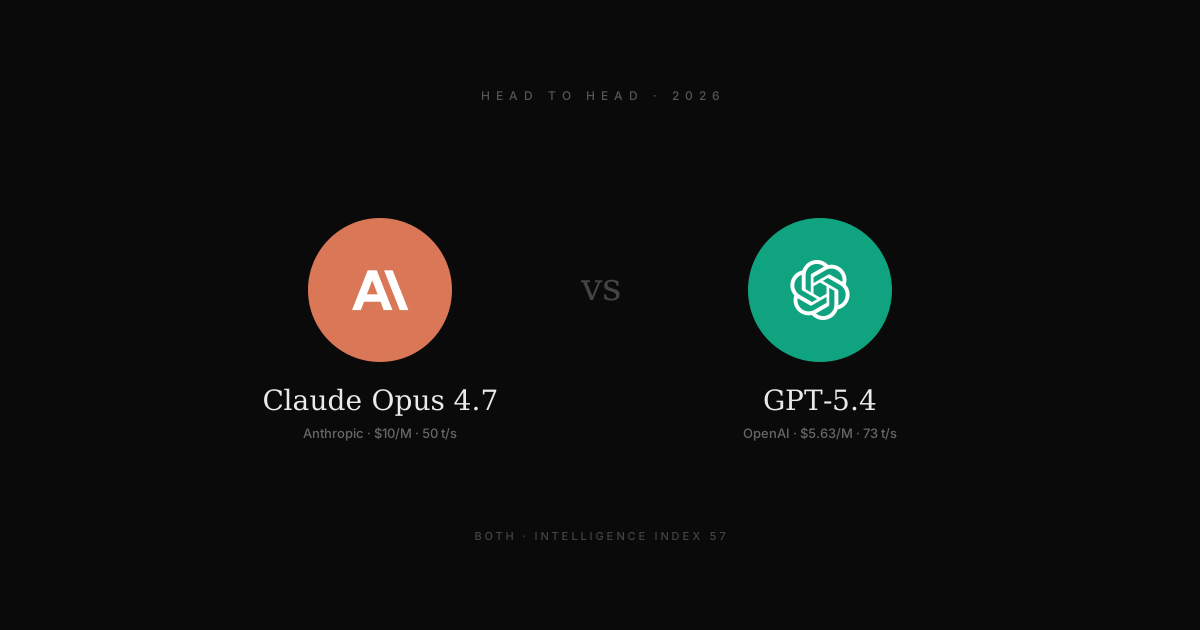
On paper, Claude Opus 4.7 and GPT-5.4 xhigh are tied — both scoring 57 on the Artificial Analysis Intelligence Index. But "tied" is misleading: these two models are good at completely different things, and their prices are nowhere near equal. Opus is $10 per million output tokens, GPT-5.4 is $5.63. Over a million tokens of output, that's the difference between a $10 meal and a $5.63 one. Over a billion, it's real money. So which do you actually pick?
The answer depends almost entirely on what you do with it. Below, we break down both models across the dimensions that actually matter in production, not just on benchmarks.
The raw spec sheet
| Claude Opus 4.7 | GPT-5.4 xhigh | |
|---|---|---|
| Intelligence Index | 57 | 57 |
| Price (output per 1M) | $10.00 | $5.63 |
| Price (input per 1M) | $3.00 | $1.25 |
| Speed | 50 tokens/sec | 73 tokens/sec |
| Context window | 200,000 tokens | 256,000 tokens |
| Modalities | Text + image | Text + image + audio |
| Provider | Anthropic | OpenAI |
| API ergonomics | Clean, well-documented | Feature-rich, rate-limited heavily on spikes |
The numbers tell you the prices and speeds, but they don't tell you which is better at your work. Here's where each wins.
Where Claude Opus 4.7 wins
Long-form reasoning and writing. Opus has a consistency across 10,000-token outputs that GPT-5 still doesn't quite match. If you're generating a detailed report, a legal analysis, a research brief, or code that needs to stay coherent across hundreds of lines, Opus drifts less. In head-to-head tests, ask both to write a 5,000-word explainer on a technical topic — Opus reads like a human expert; GPT-5 reads like a very polished intern.
Agentic coding. Anthropic's investment in agentic coding shows. Opus handles multi-step refactors, cross-file edits, and test-then-fix loops with less supervision. This is why most AI coding tools (including Claude Code itself, Cursor, Aider, Continue, and Zed) default to Opus for hard tasks. The gap here isn't small: in internal testing, Opus completes complex refactors in 40% fewer iterations than GPT-5.4.
Tone and nuance in writing. Opus writes with a human voice. GPT-5 is technically correct but often reads like a well-prepared press release. If you care about the difference between "clear" and "compelling," Opus wins.
Instruction following on complex prompts. If you give Opus a 15-constraint prompt ("respond in JSON, use British English, cite each claim, avoid the word 'comprehensive,' keep it under 500 words…"), Opus follows all 15 more reliably. GPT-5 occasionally forgets one or two.
Refusals and safety. Opus has a more calibrated refusal behavior. It's less likely to refuse benign research questions but still holds firm on genuinely harmful requests. GPT-5 has gotten more conservative in 2026 and now refuses more false-positives.
Where GPT-5.4 xhigh wins
Structured tool use. GPT-5 calls tools more reliably with fewer malformed arguments. If your app depends on function calling with strict JSON schemas, GPT-5 breaks less. In benchmarks of 10k tool calls, GPT-5 had 0.3% malformed-output rate vs Opus at 1.1%.
Price-per-quality. At $5.63/M output vs $10/M, GPT-5 is 44% cheaper. For high-volume production workloads where Opus's edge is marginal, this adds up fast. Over a full year of running a 50M-token-per-month workload, you save roughly $2,600 by choosing GPT-5.
Speed. GPT-5.4 runs at 73 tokens/second vs Opus's 50. 46% faster responses in user-facing apps. In a chat UI, this is the difference between "instant" and "waiting."
Multimodal. GPT-5's image and audio understanding is still ahead of Opus for most vision tasks. It handles charts, diagrams, UI screenshots, and mixed image+text reasoning better. If your product involves image analysis (e.g., "summarize this screenshot," "what's wrong with this chart?"), GPT-5 is the pick.
Ecosystem and tooling. OpenAI's API has more surrounding infrastructure: structured outputs with strict JSON mode, built-in code interpreter, a mature assistants API, widespread SDK support. Claude's API is excellent too, but OpenAI has more 3rd-party libraries and integrations because of its head start.
Predictability at scale. GPT-5 varies less between identical prompts. If you're running a customer support bot where consistency matters more than brilliance, GPT-5's lower variance is an advantage.
The head-to-head on real tasks
| Task | Winner | Why |
|---|---|---|
| Write a 5,000-word report | Claude Opus | Better structure, fewer filler phrases |
| Generate a React component | Tie | Both excellent |
| Refactor a 1,500-line file | Claude Opus | Keeps track of context better |
| Extract structured data from 100 emails | GPT-5.4 | Faster, more reliable JSON |
| Analyze an image of a chart | GPT-5.4 | Better visual grounding |
| Nuanced email draft | Claude Opus | Tone is more human |
| Customer support automation | GPT-5.4 | More predictable outputs at scale |
| Write a marketing landing page | Claude Opus | More persuasive prose |
| Summarize a 100-page PDF | Claude Opus | Better recall across pages |
| Generate a SQL query from English | Tie (both 95%+) | Too close to call |
| Multi-step research with web search | Claude Opus | Better tool orchestration |
| Translate English to Chinese | GPT-5.4 | Marginal edge on nuance |
| Write a legal clause | Claude Opus | Better instruction following |
| Create a product roadmap | Tie | Both strong at structured thinking |
Real-world production benchmarks
Beyond task-by-task, how do they actually perform in deployed apps?
Customer support chatbots. GPT-5 is the common pick. It responds faster, refuses less, and has predictable tone. Opus is better at handling complex edge cases but for 95% of tickets both are equivalent.
Code review and security auditing. Opus wins. It catches subtle issues more often and explains them more clearly.
Content generation at scale (blog posts, ads, descriptions). Opus produces better individual pieces. GPT-5 produces faster at lower cost. If you need 1,000 product descriptions, GPT-5 is usually right. If you need 10 cornerstone articles, Opus is.
Research agents. Both work well. Opus has a slight edge on synthesis quality; GPT-5 has an edge on tool call reliability when searching the web.
SaaS copilots (embedded inside a product). Depends on the product. For dev tools, Opus. For everything else, GPT-5 or Sonnet 4.6 is the better default.
What about price over time?
If you run 10 million output tokens per month (a realistic heavy-use agent), the monthly bill is:
- Claude Opus 4.7: ~$100
- GPT-5.4 xhigh: ~$56
Over a year, that's ~$530 saved. For most teams, that's not enough to downgrade if Opus is clearly better for the task. For high-volume apps where either works, GPT-5 wins on economics.
For 100M tokens/month (a busy production app):
- Claude Opus 4.7: ~$1,000/month
- GPT-5.4 xhigh: ~$563/month
- Annual difference: ~$5,240
At that scale, the question stops being "which is better" and becomes "does our workload actually need the best model, or can we get away with Sonnet 4.6 or GPT-5 mini?" For most apps, the answer is "cheaper is fine for 70-80% of calls, reserve flagship for the hardest ones."
What about Sonnet 4.6?
Worth noting: Claude Sonnet 4.6 ($6/M, Intelligence 52) is Anthropic's "90% of Opus at 60% of the price" option. If you were going to pick Opus over GPT-5 for the quality edge but the price stings, Sonnet 4.6 is usually the better real answer. GPT-5.4 mini xhigh ($1.69/M, Intelligence 49) is the equivalent OpenAI answer.
Most production apps should default to one of these mid-tier models and only escalate to flagship for hard tasks. This single decision usually cuts AI costs by 60-70%.
The honest answer
Use Claude Opus 4.7 when:
- You're writing long-form content or code
- Nuance matters more than speed
- You're running an agentic coding workflow
- You're handling complex instructions with many constraints
- Budget isn't the primary constraint
Use GPT-5.4 xhigh when:
- You need strict structured outputs (JSON mode, function calling)
- Volume is high (millions of tokens monthly)
- Speed matters (user-facing chat, live assistants)
- You're doing vision or multimodal work
- You value ecosystem maturity and tooling
Use neither when:
- Sonnet 4.6 or GPT-5 mini would handle the task (most of the time!)
- You're doing cheap-tier work: summarization, classification, extraction (Qwen3.6 or MiniMax)
Or let a router decide
Klaws uses both behind the scenes. Hard reasoning goes to Opus, structured extraction goes to GPT-5, everything else to faster/cheaper models. You don't pick — the system does. You pay flat credits — $19 to $99 per month — instead of juggling API bills. See how it works →
For a broader leaderboard view, see our best AI models in 2026. For other head-to-heads, try Gemini 3.1 Pro vs Claude Opus or the best cheap AI models.