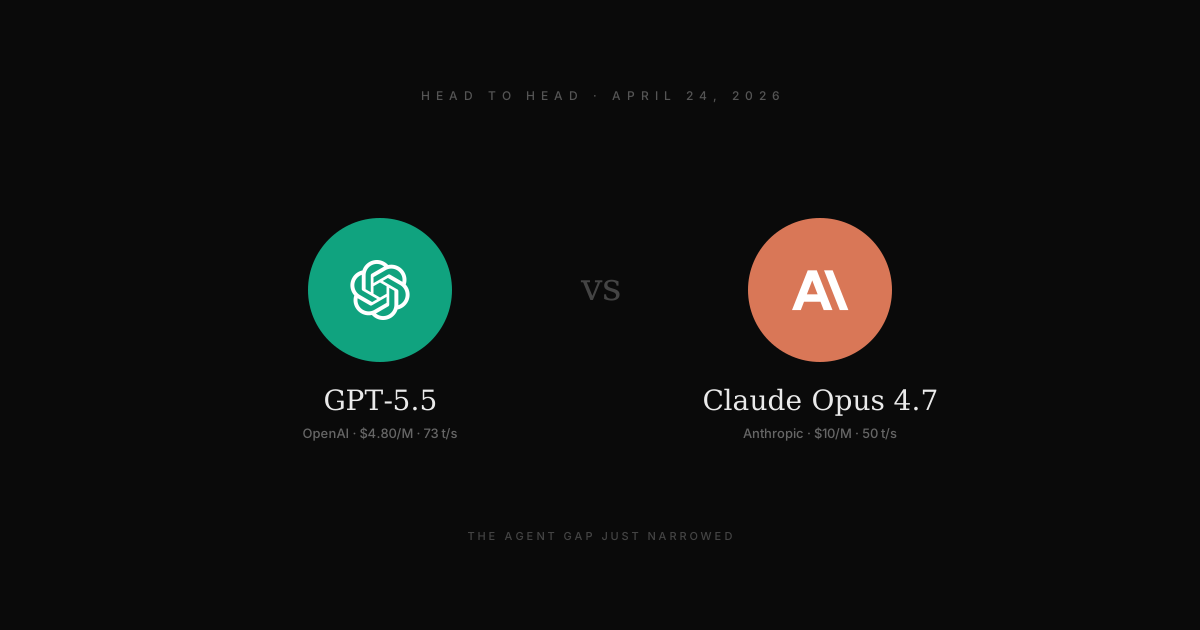
Short answer: GPT-5.5 closed most of the agent gap, Opus 4.7 is still ahead on long-form writing and hard coding, and the economics tilted harder in OpenAI's favor. If you've been running a mix, the ratio should tilt toward GPT-5.5 this week — but not go all-in.
OpenAI's April 23 release of GPT-5.5 is the most consequential frontier drop since GPT-5.0 — not because the headline benchmarks moved a lot (they didn't), but because the failure modes that pushed teams onto Opus for agent work mostly went away. Below is the updated head-to-head, with fresh pricing, fresh task boundaries, and the honest version of "which do I pick?"
For what changed under the hood on the OpenAI side, see our GPT-5.5 launch rundown and the agent-specific post. This post is about the comparison.
The raw spec sheet
| GPT-5.5 xhigh | Claude Opus 4.7 | |
|---|---|---|
| Intelligence Index | 57 | 57 |
| 15-step agent-chain success | ~84% (up from 62% on 5.4) | ~91% |
| Tool-call schema accuracy | 99.8% | 98.9% |
| Price (output per 1M) | $4.80 | $10.00 |
| Price (input per 1M) | $1.06 | $3.00 |
| Speed | 73 tokens/sec | 50 tokens/sec |
| Context window | 256,000 tokens | 200,000 tokens |
| Modalities | Text + image + audio | Text + image |
| Provider | OpenAI | Anthropic |
GPT-5.5 is now 52% cheaper per output token than Opus, and roughly 65% cheaper on input. For high-volume workloads where Opus's quality edge is subjective, the economics have gotten hard to ignore.
Where GPT-5.5 wins (the new ground)
Long-running agent chains. This is the headline shift. GPT-5.4 lost coherence past step 8; GPT-5.5 holds through step 15+, re-reads earlier context when something looks off, and revises mid-task. If your agent does overnight work, scheduled tasks, or multi-tool research, 5.5 is meaningfully better than 5.4 was — and close enough to Opus that the premium is hard to justify for tool-heavy flows.
Structured output reliability. Near-perfect JSON schema adherence. If your pipeline has a "retry on malformed output" branch, you can probably delete it.
Tool discretion. Agents on 5.5 stop over-calling tools — fewer superfluous web searches, fewer redundant file reads. Real savings on top of the token price drop.
Error recovery. When a tool returns an error, 5.5 reads it and adapts: wait on a rate limit, fix a malformed argument, escalate to the user when the tool is genuinely broken. That's the behavior teams were scaffolding in code pre-5.5.
Speed. 73 tokens/sec vs Opus's 50 — 46% faster user-facing output. In a chat UI, that's the gap between "instant" and "waiting a beat."
Multimodal. Unchanged from 5.4 but still ahead — chart reading, screenshot analysis, vision reasoning.
Ecosystem maturity. Wider SDK surface: strict JSON mode, code interpreter, assistants API, more 3rd-party integrations.
Where Claude Opus 4.7 still wins
Long-form writing. Nothing changed. Opus at 5,000+ words reads like an expert; GPT-5.5 still reads like a polished intern. If your product is content — cornerstone articles, legal drafts, brand-voice email — Opus is still the pick.
Hard agentic coding. Cross-file refactors on large repos, multi-hour test-then-fix loops, dependency-graph understanding. Opus still leads here, and the gap only partially closed. Claude Code, Cursor composer mode, Aider, and Zed still default to Opus for hard tasks for a reason.
Tone and nuance. GPT-5.5 didn't change voice. Opus is still better at persuasive prose, nuanced emails, and anything where how it reads matters as much as what it says.
Complex instruction following. On 15-constraint prompts ("respond in JSON, British English, cite each claim, under 500 words, avoid 'comprehensive'..."), Opus still catches all constraints more reliably. GPT-5.5 improved but occasionally drops one.
Calibrated refusals. Opus refuses fewer benign requests while holding firm on genuinely harmful ones. GPT-5's 2026 tuning leans conservative.
The head-to-head on real tasks (updated)
| Task | Winner | Notes |
|---|---|---|
| Write a 5,000-word report | Claude Opus | Voice and structure, unchanged |
| Generate a React component | Tie | Both excellent |
| Refactor a 1,500-line file | Claude Opus | Context tracking edge holds |
| Multi-tool research agent (10+ steps) | GPT-5.5 | The 5.5 unlock |
| Extract JSON from 100 emails | GPT-5.5 | Schema near-perfect |
| Analyze a chart image | GPT-5.5 | Vision lead holds |
| Nuanced email draft | Claude Opus | Human voice |
| Customer support automation | GPT-5.5 | Predictability + price |
| Marketing landing page copy | Claude Opus | Persuasive prose |
| Summarize a 100-page PDF | Claude Opus | Recall across pages |
| SQL from English | Tie | Both 95%+ |
| Research agent with web search | GPT-5.5 now (was Opus) | Tool use improved enough |
| Translate EN → ZH | GPT-5.5 | Marginal edge |
| Legal clause draft | Claude Opus | Instruction following |
| Overnight scheduled agent | GPT-5.5 | Long-horizon reliability |
Two rows flipped from Opus to GPT-5.5 since the previous comparison: multi-tool research and web-search agents. Those are the exact workloads 5.5 was tuned for.
The cost math (updated)
Heavy agent workload, 10M output tokens/month:
- GPT-5.5 xhigh: ~$48
- Claude Opus 4.7: ~$100
- Savings with 5.5: ~$52/month, ~$620/year
Production app, 100M output tokens/month:
- GPT-5.5 xhigh: ~$480
- Claude Opus 4.7: ~$1,000
- Savings with 5.5: ~$520/month, ~$6,240/year
And because 5.5 retries failed tool calls less often, cost-per-successful-task drops another ~25% on top of the token price cut — closer to 35-40% total savings for agent workflows versus Opus. Not nothing.
What about mid-tier?
The "90% quality at 40% price" slot keeps getting more interesting:
- Claude Sonnet 4.6 — $6/M, Intelligence 52. Still Anthropic's go-to for the middle tier.
- GPT-5.5 mini — ~$1.44/M output (down ~15% from 5.4-mini), Intelligence 49. Close enough that most bulk production work should default here.
For most real stacks, the right answer in April 2026 is:
- Flagship tier (hard work): Opus for writing/coding, GPT-5.5 for agents.
- Mid-tier (80% of calls): Sonnet 4.6 or GPT-5.5 mini.
- Cheap tier (classification, extraction, routine): Qwen 3.6 or MiniMax.
One model for everything is a recipe for overspending.
The honest pick
Use GPT-5.5 xhigh when:
- Agent workflows with many tools or long chains
- Strict structured outputs (JSON schemas, function calls)
- Vision / multimodal input
- Volume is high, speed matters, cost sensitivity is real
- Overnight or scheduled autonomous work
Use Claude Opus 4.7 when:
- Long-form writing or persuasive copy is the product
- Hard agentic coding on large repos
- Voice, tone, or nuance matters
- Complex multi-constraint instructions
- Budget isn't the primary constraint
Use neither when:
- Sonnet 4.6 or GPT-5.5 mini would do fine (most of the time)
- Cheap-tier extraction or classification (Qwen 3.6, MiniMax)
Or let a router decide
Klaws routes across both behind the scenes. Long-form writing and hard code goes to Opus. Tool-heavy and structured agent work goes to GPT-5.5. Everything else to cheaper/faster models. You don't pick — the system does. Flat monthly credits ($19–$99) instead of juggling two API bills. See how it works →
For the wider leaderboard, see best AI models in 2026. For the previous GPT-5.4 comparison (still accurate for pre-5.5 deployments), see Claude Opus vs GPT-5. For the Gemini side, see Gemini 3.1 Pro vs Claude Opus.