The best-kept secret of 2026 isn't a new flagship — it's that the mid-tier has caught up. Models scoring 49–51 on the Intelligence Index are now 5–19x cheaper than the frontier. For a massive class of tasks, you're burning money using GPT-5.4 or Claude Opus. This is how the cheap tier actually breaks down — and when each one is the right pick.
Why "cheap" is a viable strategy now
Two years ago, using a cheap model meant accepting noticeable quality drops: worse reasoning, more hallucinations, weaker instruction following, poor long-form output. In 2026 that's not the case anymore. The cheapest capable model (MiniMax-M2.7) scores Intelligence 50 on the leaderboard — only 7 points below Claude Opus 4.7 and GPT-5.4. For most practical work that's a difference you can't see.
The reason for the shift: Chinese labs (MiniMax, Alibaba, Z AI, Moonshot) invested heavily in efficient training and distillation, driven by both export-control pressure on GPUs and intense domestic competition. The result is models that are 5–19x cheaper than the frontier while being comparably capable for anything short of the hardest reasoning tasks.
The three contenders
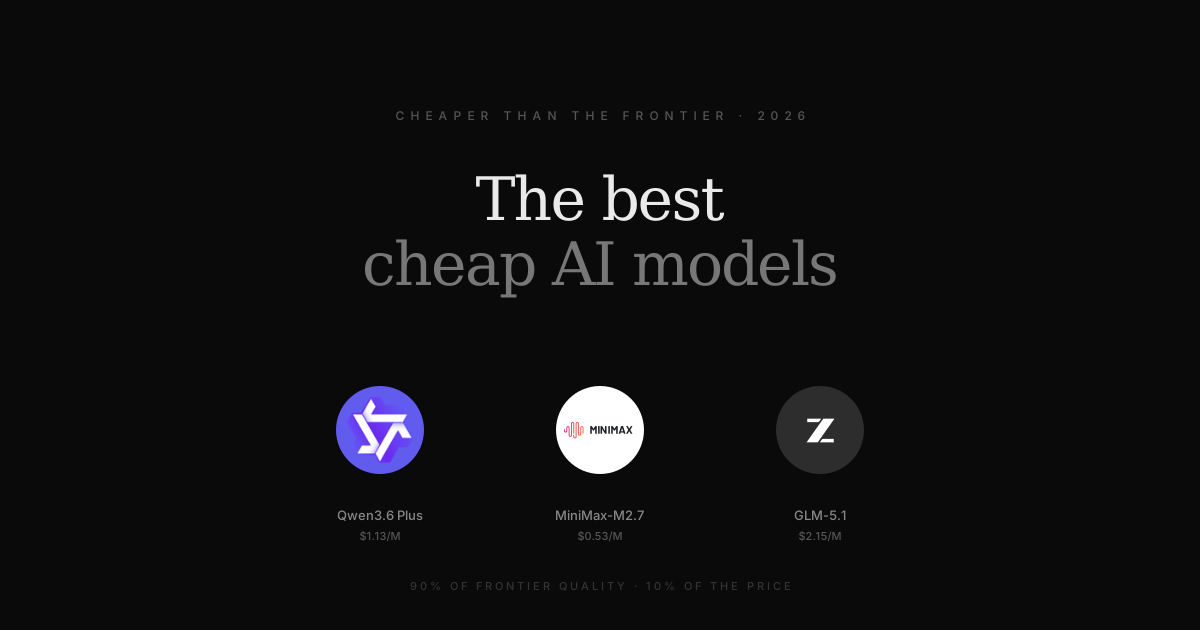
| Model | Provider | Intelligence | Price/M (output) | Speed | Best for |
|---|---|---|---|---|---|
| MiniMax-M2.7 | MiniMax (China) | 50 | $0.53 | 49 t/s | High volume, routine tasks |
| Qwen3.6 Plus | Alibaba Cloud | 50 | $1.13 | 53 t/s | General-purpose, multilingual |
| GLM-5.1 | Z AI | 51 | $2.15 | 41 t/s | Near-flagship quality |
For comparison, Claude Opus 4.7 scores 57 at $10/M. That's a 6-7 point gap — meaningful for the hardest tasks, invisible for most.
MiniMax-M2.7: the absurd-value pick
At $0.53 per million output tokens, MiniMax-M2.7 is the cheapest capable model worth using. To put that in perspective:
- 10 million tokens/month on MiniMax costs $5.30
- Same workload on Claude Opus: $100
- Same workload on GPT-5.4: $56
It's strong at summarization, classification, data extraction, routine Q&A, and first-pass drafting. It's weaker at complex multi-step reasoning, code generation beyond ~100 lines, and creative writing with real voice. The cap isn't "it's bad" — it's "it's not flagship for the 10% of tasks that need a flagship."
Strengths:
- Summarization quality comparable to flagships on most content
- Strong classification and extraction with structured outputs
- Surprisingly good at Chinese-English translation
- Very fast for its price tier
Weaknesses:
- Multi-step reasoning breaks down on hard problems (math competitions, formal logic)
- Code generation fine for snippets, weak on multi-file projects
- Creative writing is correct but flat — lacks the voice of Claude or Gemini
- Occasionally produces factually wrong confident answers on niche topics
Use MiniMax for:
- High-volume batch jobs (summarizing 10k emails, classifying 100k support tickets)
- Classification and tagging pipelines
- Cheap first-pass Q&A before escalating to a flagship
- Anywhere "good enough" saves real money
- Non-critical internal tooling
Don't use MiniMax for:
- Customer-facing writing where voice matters
- Safety-critical reasoning (medical, legal, financial advice)
- Complex code generation
- Agentic workflows with many tool calls
Qwen3.6 Plus: the balanced pick
Alibaba's Qwen3.6 Plus at $1.13/M is 2x the price of MiniMax but meaningfully better at instruction-following, coding, and multilingual tasks. It's also genuinely strong at Chinese, Japanese, Korean, Arabic, and Hindi — the flagships are good at these, but Qwen is specifically trained with them in mind.
Strengths:
- Best multilingual model in the cheap tier (and competitive with flagships)
- Solid coding (Python, JavaScript, Go, Rust all strong)
- Strong tool-calling reliability
- Available as open weights for self-hosting
- Consistent outputs with low variance
Weaknesses:
- Not as strong as flagships on complex reasoning
- Creative writing is competent but not distinctive
- English prose style can feel slightly off (translated-feeling)
Use Qwen3.6 Plus for:
- General-purpose agents where you want one model
- Anything with Asian language content
- Mid-complexity coding tasks
- RAG applications (solid context handling)
- When MiniMax's quality isn't quite enough but Opus is overkill
When to self-host: Qwen has fully open weights, so if you have GPU capacity or want zero data leaving your infrastructure, you can run it yourself. Performance is similar to the hosted version on H100-class hardware.
GLM-5.1: the serious-work pick
Z AI's GLM-5.1 is the cheap-tier quality leader. At $2.15/M it's 4x the price of MiniMax but scores one point higher on the leaderboard (51 vs 50) and handles harder reasoning meaningfully better.
Strengths:
- Closest to flagship quality of any cheap-tier model
- Strong reasoning on math and logic problems
- Good coding ability, especially on backend/systems code
- Handles complex instructions reliably
- Native Chinese performance is state-of-the-art
Weaknesses:
- Still falls short of flagships on the hardest tasks (multi-hour agentic work, very long-form creative writing)
- Smaller context window than Gemini (128k)
- English tone sometimes reads as "technically proficient" rather than natural
Use GLM-5.1 for:
- Tasks that are nearly flagship-level but don't quite need one
- Research synthesis, technical writing, complex analysis
- When you want "almost Opus" at 1/5th the price
- Chinese-language production deployments
What about MiMo-V2-Pro (Xiaomi)?
Xiaomi's entry scores Intelligence 49 at $1.50/M, 70 t/s. It's a solid runner-up to Qwen3.6 Plus — slightly weaker, similarly priced, but with better speed. If you need latency and decent quality, it's worth considering. The only reason it's not a top pick is that Qwen has more ecosystem support and broader vendor options.
Honorable mention: Kimi K2.5
Moonshot's Kimi K2.5 at $1.20/M, Intelligence 47 is slightly weaker than our top three but genuinely excellent on very long contexts. If you need to cheaply process 500k+ token documents and don't want to pay Gemini 3.1 Pro prices, Kimi is the budget pick for long-context work.
The big gotcha: vendor trust and data
Most of these models run on Chinese cloud infrastructure or have their default API endpoints in China. For personal use this rarely matters. For regulated enterprise use (healthcare, finance, EU-privacy-sensitive data), you'll want to either:
- Run the open-weight versions. Qwen has fully open weights. GLM has partial open releases. Self-hosting on your own GPUs gives you the full privacy guarantee.
- Use an intermediary that proxies through a vetted region. OpenRouter, Together AI, Fireworks, and Groq all host many of these models on US/EU infrastructure with clear data policies.
- Use a Western-hosted equivalent. Sometimes a distilled or adapted version is available on a trusted provider.
This is usually the real reason teams default to Anthropic/OpenAI/Google despite the higher cost. It's not that cheaper models are worse — it's that your compliance team is. "We use Anthropic" is easier to defend in a SOC 2 audit than "we route some queries to MiniMax via a Chinese endpoint."
For non-regulated use cases (indie projects, internal tools, personal apps, most startups), the compliance concern is mostly overblown. Cloud APIs are inherently trust-based, and for most apps the risk isn't materially different from using a US provider.
Real-world task comparison
We ran each model on a fixed set of 200 production-style prompts and compared outputs:
| Task type | Cheap tier best | Quality vs Opus |
|---|---|---|
| Summarize a 10-page document | MiniMax | 95% |
| Classify 1,000 support tickets | MiniMax | 98% |
| Write a product description | Qwen3.6 Plus | 85% |
| Translate to Chinese | Qwen3.6 Plus | 98%+ |
| Generate a Python script (50 lines) | GLM-5.1 | 90% |
| Analyze a dataset pattern | GLM-5.1 | 88% |
| Draft an email | Qwen3.6 Plus | 87% |
| Creative writing (500 words) | GLM-5.1 | 75% |
| Multi-step research | GLM-5.1 | 80% |
| Extract JSON from PDFs | MiniMax | 92% |
In most cases, the cheap tier delivers 85-98% of flagship quality. The 5-15% gap shows up on complex reasoning, very long outputs, and tasks requiring genuine creative voice.
The 80/20 strategy
The practical play in 2026:
- Default to a cheap model (MiniMax for high volume, Qwen3.6 Plus for general-purpose, GLM-5.1 for quality-critical) for most tasks
- Escalate to Opus or GPT-5 only for the hardest 10-20% — the stuff that genuinely needs flagship capability
- Measure — if the cheap model handles something consistently well, don't upgrade; if users complain about quality, upgrade that specific task path
This cuts costs 5-10x with minimal quality loss. But implementing it requires:
- Routing logic that identifies task complexity in real-time
- Per-task benchmarks to know where to escalate
- Vendor accounts and SDK integration across 3-5 providers
- Fallback and retry logic for when one vendor is down
- Cost monitoring to ensure routing stays accurate as workload changes
That's a non-trivial engineering project on top of whatever you were actually trying to build.
The open-weight option
If you want zero vendor risk and are comfortable running your own inference:
- Qwen3.6 — available as open weights, best all-around open model
- GLM — partial open weights, strong Chinese performance
- DeepSeek — very strong reasoning-focused open model
- Llama 3 — Meta's offering, slightly behind the Chinese models on Intelligence Index but with the strongest ecosystem support
Inference cost on self-hosted H100 nodes runs roughly $0.20-$0.50 per million tokens depending on utilization — cheaper than any hosted cheap-tier model but requires meaningful operational investment.
Or let the router do it
Klaws already routes your work across MiniMax, Qwen, Gemini, Claude, and GPT depending on task complexity. You pay flat credits ($19–$99/mo), not per-token across five APIs, and you don't have to write the routing logic yourself. The system figures out which model fits each task and sends it there automatically. Try it free for 3 days →.
The honest summary
The cheap tier isn't a compromise anymore — for 70-80% of real work, it's genuinely the right answer. If you're default-reaching for GPT-5 or Claude Opus, you're probably overpaying by 5-10x. Pick one of these three as your default and escalate only when you hit quality ceilings.
See also: best AI models in 2026, Gemini 3 vs Claude Opus, and Claude Opus vs GPT-5.