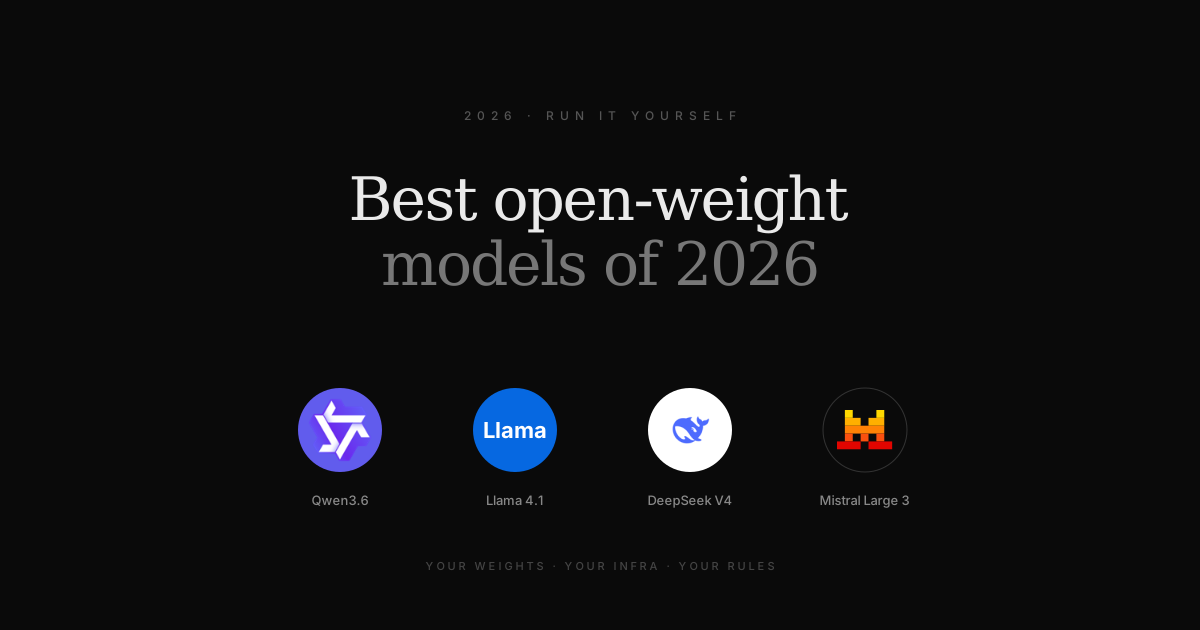
Two years ago, "open-weight" meant "a worse model you can run yourself." In 2026 it means "genuinely competitive model you can run yourself, fine-tune, and deploy without sending data to a US vendor." The open-weight tier is now a legitimate choice for serious production use, and for some companies it's the only acceptable choice. Here's how the top four compare.
The top open-weight models of 2026
| Model | Provider | Intelligence | Hosted price/M | Self-host on H100 |
|---|---|---|---|---|
| Qwen3.6 Plus | Alibaba Cloud | 50 | $1.13 | ~$0.25 |
| Llama 4.1 405B | Meta | 48 | $0.60-2.80 | ~$0.35 |
| DeepSeek V4 | DeepSeek | 49 | $0.70 | ~$0.30 |
| Mistral Large 3 | Mistral AI | 47 | $2.00 | ~$0.30 |
All four have fully open weights downloadable from Hugging Face. All four have permissive licenses for commercial use (with some restrictions — read them).
Qwen3.6 Plus — the best all-arounder
Alibaba's Qwen3.6 Plus is the best open-weight model for general-purpose use. It's strong at:
- Instruction following — follows complex multi-constraint prompts reliably
- Multilingual — best open model for Chinese, Japanese, Korean, Arabic
- Coding (Qwen3.6 Coder variant) — SWE-bench 66%, best open-weight coder
- Tool use — clean function calling, works with OpenAI-compatible tool schemas
- Fine-tuning — extensive tooling, LoRA and full fine-tune work out of the box
Weaknesses:
- Smaller context window than Gemini (128k)
- Creative writing in English is competent but not distinctive
- The very largest variants (235B active-parameter MoE) need serious hardware
Qwen3.6 is available in multiple sizes (7B, 32B, 72B, and the flagship MoE). Most production deployments use the 72B or MoE variants.
Llama 4.1 — the ecosystem winner
Meta's Llama 4.1 405B is slightly behind Qwen on benchmarks but has an enormous ecosystem advantage. More tools, more fine-tuning guides, more serving frameworks, more community projects. It's the default "open-weight LLM" everyone starts with.
Strengths:
- Huge community and tooling ecosystem
- Multiple active-parameter sizes (8B, 70B, 405B, plus MoE variants)
- Well-calibrated safety (not over-refusing)
- Available on every inference provider (Groq, Cerebras, Together, Fireworks, etc.)
- Native tool-use and function-calling support
Weaknesses:
- Slightly behind Qwen3.6 on most benchmarks
- Less strong at non-English languages
- License has some restrictions around very-large-company usage
Llama 4.1 70B is the sweet spot for most production deployments — good quality, affordable to serve, and supported everywhere.
DeepSeek V4 — the reasoning pick
DeepSeek's MoE architecture produces exceptional results on reasoning-heavy tasks (math, logic, algorithmic code) at relatively low inference cost. It punches above its price tier on anything that looks like "hard thinking."
Strengths:
- Best open-weight model for math and logic
- Strong at step-by-step reasoning
- Efficient MoE architecture — lower per-token inference cost
- Available cheaply on SambaNova and Fireworks at high speed
Weaknesses:
- Weaker on creative writing than Qwen/Llama
- Safety calibration is less mature
- Multilingual support not as deep as Qwen
Mistral Large 3 — the European option
Mistral's Large 3 is the best European open-weight model and has gotten significant adoption in EU-regulated industries (finance, healthcare) because of data sovereignty concerns. Quality is slightly below the others but close enough that compliance benefits often decide.
Strengths:
- European company — easier for GDPR / data sovereignty
- Strong at European languages (French, German, Spanish, Italian)
- Good tool use
- Commercial license is friendly to enterprises
Weaknesses:
- Slightly behind on benchmarks
- Smaller ecosystem than Llama
- More expensive on most hosted providers
When to self-host
Hosted APIs for these models typically run $0.50-2.00 per million tokens. Self-hosting on rented GPU instances runs $0.25-0.35 per million at moderate utilization. The breakeven point:
- Below 10M tokens/month: hosted is cheaper (you don't pay for idle GPU time)
- 10M-100M tokens/month: roughly equal
- Above 100M tokens/month: self-hosting saves meaningful money
But cost isn't the main reason to self-host. Real reasons:
- Data never leaves your infrastructure (regulated industries)
- Custom fine-tuning on your company's data
- Zero vendor lock-in — you own the model
- Predictable costs — GPU rental vs per-token scaling
- Latency — co-locating with your app eliminates network hops
- Availability — no API outage can take you down
Serving infrastructure
The practical options for self-hosting in 2026:
- vLLM — open source, mature, best throughput for most models
- TensorRT-LLM — NVIDIA's optimized runtime; highest performance on H100/H200
- SGLang — newer, strong for complex serving patterns
- llama.cpp — CPU/Mac inference, for smaller models or local dev
Cloud options that run open-weight models for you:
- Together AI — broadest catalog, per-token pricing
- Fireworks — strong performance, custom fine-tuning
- Groq — extreme speed on smaller Llama variants
- Cerebras — extreme speed on largest Llama variants
- SambaNova — optimized for DeepSeek
The decision tree
Need the best open-weight quality? → Qwen3.6 Plus
Need the best ecosystem/tooling? → Llama 4.1
Doing math/logic/algorithmic work? → DeepSeek V4
European enterprise with data sovereignty concerns? → Mistral Large 3
Not sure? → Start with Llama 4.1 70B hosted on Together AI. Cheapest way to prototype, easy to migrate.
How Klaws uses open-weight models
For agent workloads where data sensitivity matters, Klaws can route to Qwen3.6 on Fireworks or Llama 4.1 on Groq instead of the Western flagships. You get comparable quality without sending prompts to Anthropic/OpenAI/Google. See how →
See also: best cheap AI models, best AI models for coding, best AI models 2026.