On April 20, 2026, Moonshot AI open-sourced Kimi K2.6 — a 1-trillion-parameter agentic model with a Modified MIT license, a 256K context window, and native multimodal input. The pitch is narrow and sharp: the best autonomous coding agent on the open-weights market, aimed squarely at Claude Opus and GPT-5.
The numbers hold up. Here's the full technical breakdown — and what it means if you're running AI agents in production.
The benchmark story
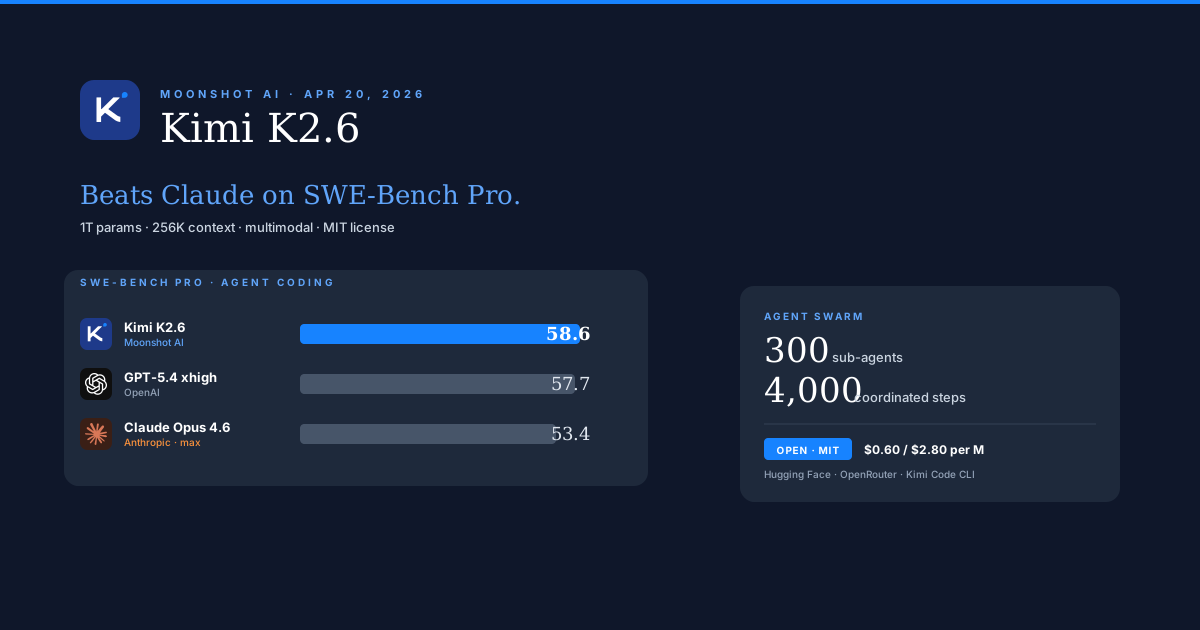
K2.6 is the first open-weight model to beat frontier proprietary models on agentic coding benchmarks. Scores from Moonshot's release (independently referenced across MarkTechPost, SiliconANGLE, and Kilo AI):
| Benchmark | Kimi K2.6 | Claude Opus 4.6 | GPT-5.4 (xhigh) | Gemini 3.1 Pro |
|---|---|---|---|---|
| SWE-Bench Pro | 58.6 | 53.4 | 57.7 | — |
| HLE-Full (tools) | 54.0 | 53.0 | 52.1 | 51.4 |
| Sub-agent scaling | 300 agents / 4,000 steps | N/A | N/A | N/A |
SWE-Bench Pro measures real-world software engineering — unresolved GitHub issues with PRs as ground truth. A 5-point jump over Claude Opus 4.6 at max effort is the biggest single-release leap since K2.0.
Humanity's Last Exam (HLE) with tools is the other headline. K2.6 leads every frontier model, proprietary or open. The tool-use column matters — it tests the agent's ability to reason, call functions, integrate results, iterate. That's the shape of real work, not multiple-choice trivia.
What "300 sub-agents, 4,000 steps" actually means
The architectural claim is the interesting one. K2.5 capped at 100 parallel sub-agents executing up to 1,500 steps. K2.6 triples both. For context:
- 100 agents × 1,500 steps (K2.5) = enough to parallelize a medium refactor or research sweep.
- 300 agents × 4,000 steps (K2.6) = enough to refactor a full monorepo, run a multi-day research loop, or orchestrate hundreds of scraping/analysis tasks concurrently without the LLM losing the thread.
This is what "agentic" looks like when it actually works. A model that routinely breaks at step 400 is a chatbot with delusions. K2.6 is the first open model with claim support for real long-horizon execution.
Pricing and availability
Access paths:
- Kimi.com web — free tier for light use
- API via Moonshot —
moonshotai/kimi-k2.6on OpenRouter and kilo.ai - Hugging Face — weights under Modified MIT License
- Kimi Code CLI — Moonshot's own Claude Code-style agent runner
OpenRouter lists K2.6 at $0.60 per million input tokens and $2.80 per million output tokens — materially cheaper than Claude Opus 4.6 at max effort and GPT-5.4 xhigh. For agent workloads where output tokens dominate, the K2.6 price point is the difference between running 50 agents per day and several hundred.
Architecture highlights
The 1T-parameter figure is active-parameter MoE. From the SiliconANGLE breakdown:
- Mixture-of-Experts with attention-sink optimizations for long-context stability
- 256K context window (vs Claude's 200K, GPT-5.4's 256K, Gemini 3.1 Pro's 2M)
- Native multimodal — image + text in, structured output out
- Agent-swarm orchestration baked into the inference pipeline, not a wrapper
The attention optimizations matter more than the parameter count. Most 1T MoE models degrade past 100K tokens — K2.6 holds accuracy through 256K because attention is reformulated around high-information tokens.
Where K2.6 still loses
Be honest about the gaps:
- Multimodal reasoning ≠ Gemini 3.1 Pro. K2.6 can see images. It doesn't yet match Gemini on video understanding or 1M+ token document synthesis.
- Latency on long tasks. 4,000 coordinated steps is impressive, but a single task can take hours. If you need sub-5-second responses, stay on Haiku/Flash-class models.
- Self-hosting is non-trivial. 1T-parameter MoE at FP16 needs ~2TB of VRAM. Realistic self-host requires 8× H200 or H100 NVL nodes. For most teams, API access is the only viable path.
- Chinese-first training signal. English performance is strong, but certain US-specific contexts (legal, healthcare regulation) still lag Western frontier models.
What this means for agent platforms like Klaws
At Klaws, we route every agent task through whichever model gives the best result-per-dollar for that task type. K2.6 is the most interesting release of 2026 for one specific reason: open weights + frontier coding performance. That's a category nobody else has right now.
Concretely:
- Autonomous coding tasks (refactor, issue-fix, PR review) — K2.6 is now the default candidate, pending our own internal evals.
- General chat and quick tasks — Gemini 3 Flash stays the default (latency + cost).
- Long documents / video — Gemini 3.1 Pro stays the default (2M context + video).
- High-stakes reasoning — GPT-5.4 and Claude Opus 4.7 still lead certain reasoning benchmarks.
If you're building your own agent infrastructure, K2.6 is the first release where "use an open model for your coding agents" stops being a compromise.
How to try K2.6 today
Option 1 — Kimi.com: Fastest path. Free tier, no setup.
Option 2 — OpenRouter / kilo.ai: API access from any codebase. Use model ID moonshotai/kimi-k2.6.
Option 3 — Self-host via vLLM: Only realistic if you have 8× H100/H200 and a reason to avoid cloud API costs.
Option 4 — Klaws: Your personal AI agent that picks the right model for each task automatically. K2.6 is being added to our router this week. Start your trial and you'll have it on day one.
The honest summary
Kimi K2.6 is the first open-weight model to beat frontier proprietary models on the benchmark that actually matters for agents (SWE-Bench Pro) while also beating them on the hardest general-reasoning benchmark (HLE with tools). It's not a universal winner — Gemini 3.1 Pro still owns long-context and multimodal, GPT-5.4 still leads pure reasoning — but for building AI agents that ship code, K2.6 is the new default.
For a broader look at the 2026 model landscape, see our best AI agent platforms comparison and our Qwen 3.6 Max review. If you want to put it to work without running benchmarks yourself, try Klaws free for 3 days → — we pick the right model for every task so you don't have to.