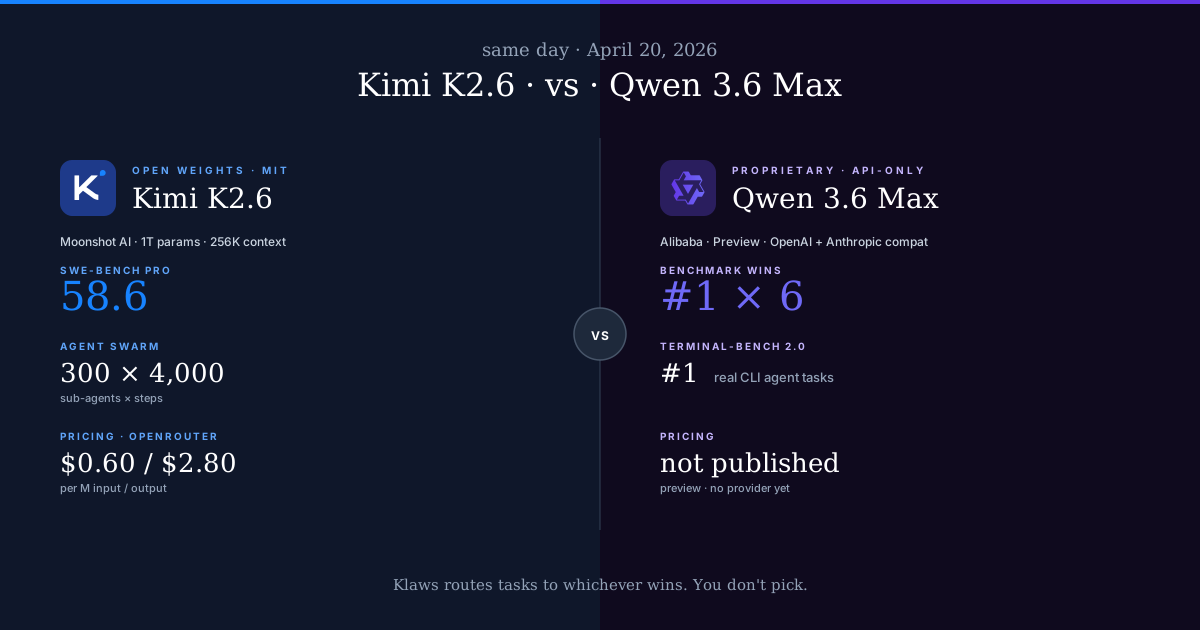
On April 20, 2026, two Chinese AI labs dropped frontier model releases within hours of each other. Moonshot AI launched Kimi K2.6, Alibaba previewed Qwen 3.6 Max, and both claim to beat Claude Opus 4.6 and GPT-5.4 on the benchmarks that matter for building AI agents.
So which one should you actually use? Here's the technical head-to-head.
At a glance
| Kimi K2.6 | Qwen 3.6 Max Preview | |
|---|---|---|
| Lab | Moonshot AI | Alibaba |
| Release | April 20, 2026 | April 20, 2026 |
| License | Modified MIT (open weights) | Proprietary (API-only) |
| Parameters | 1T (MoE) | Undisclosed |
| Context window | 256K | 256K (est., unconfirmed for Max) |
| SWE-Bench Pro | 58.6 | Claimed #1 (unverified external) |
| HLE-Full (tools) | 54.0 | Not published |
| Terminal-Bench 2.0 | Not published | #1 |
| Pricing | $0.60 / $2.80 per M (OpenRouter) | Not published · no commercial provider yet |
| API compat | OpenAI-compatible via OpenRouter | OpenAI + Anthropic native |
| Multi-agent scaling | 300 sub-agents, 4,000 steps | Not published |
Benchmark analysis
SWE-Bench Pro
K2.6: 58.6 (verified, released openly). Qwen 3.6 Max: claimed #1, exact score not yet disclosed.
Until Alibaba publishes the specific number, K2.6's 58.6 is the known frontier. For reference: GPT-5.4 xhigh = 57.7, Claude Opus 4.6 max = 53.4.
Agentic tool use
Qwen 3.6 Max ranks #1 on Terminal-Bench 2.0 and SkillsBench, which are the tightest tests of actual agent-on-a-computer performance. K2.6 hasn't published Terminal-Bench results but scores 54.0 on HLE-Full with tools (leading every model including GPT-5.4).
Takeaway: Qwen 3.6 Max likely wins on discrete tool-use benchmarks. K2.6 likely wins on long-horizon reasoning-heavy agent tasks.
Multi-agent orchestration
Only K2.6 ships with a specific claim: 300 parallel sub-agents, 4,000 coordinated steps. That's 3x the capacity of K2.5 and the highest number any lab has published.
Qwen 3.6 Max doesn't publish a sub-agent limit, which is fair — it's a preview, and "300 sub-agents" is more of a runtime architecture decision than a model capability per se. But if you're building agent swarms, K2.6's number is the only concrete one.
The open vs closed tradeoff
This is the biggest practical difference.
Kimi K2.6:
- Weights on Hugging Face under Modified MIT
- Can self-host (if you have 8× H100 NVL or H200)
- Can fine-tune on proprietary data
- Can run air-gapped
- API costs on OpenRouter: $0.60 / M input, $2.80 / M output
Qwen 3.6 Max Preview:
- No weights, no self-host
- API only via Alibaba Cloud Model Studio + Qwen Studio
- Can't fine-tune
- Must send data to Alibaba's servers
- Pricing unpublished — Artificial Analysis confirms no commercial provider yet
For any team with regulatory constraints (EU data residency, HIPAA, finance), K2.6 is the only option in this comparison. For teams who just want the best model with zero infra work, Qwen 3.6 Max is smoother once pricing is public.
Which one should you use?
Pick Kimi K2.6 if:
- You're building long-horizon coding agents (refactor, issue-fix, monorepo PRs)
- You need sub-agent orchestration at scale (>100 parallel workers)
- You have data sovereignty requirements (self-host or EU API routing)
- You care about cost at scale (~10x cheaper than Claude Opus 4.6 max)
- You want to fine-tune on proprietary code
- You can wait a few extra seconds for more thorough reasoning
Pick Qwen 3.6 Max Preview if:
- You're replacing Claude or GPT in existing production code (API compat wins)
- Your agents do heavy tool use with tight latency (Terminal-Bench #1 signal)
- You need native Chinese + English in the same pipeline
- You can't self-host and want frontier performance via API
- You want lower switching cost than moving to a new API dialect
Use something else if:
- You need video understanding or 2M context → Gemini 3.1 Pro
- You need absolute best reasoning on discrete hard problems → GPT-5.4 or Claude Opus 4.7
- You need sub-second latency for chat UX → Gemini 3 Flash or Claude Haiku
The builder's question: which one ships production agents faster?
Honest answer: it depends on what you're shipping.
For an autonomous coding agent — a thing that takes a GitHub issue, writes the PR, runs tests, iterates — K2.6 is the bet. The benchmark lead, the sub-agent capacity, and the open-weights optionality compound.
For a multi-tool business agent — a thing that uses 20 APIs, manages CRM, summarizes calls, schedules meetings — Qwen 3.6 Max's Terminal-Bench and SkillsBench lead plus Anthropic-compat API suggest faster production readiness.
For a personal agent running 24/7 — which is what Klaws is — you don't pick one. You route tasks to whichever model wins that specific task. A refactor goes to K2.6. A Gmail triage goes to Gemini 3 Flash. A competitor-monitoring sweep goes to Qwen 3.6 Max. That's the only rational strategy once you have 4+ frontier models in play.
What we're doing at Klaws
Both models go into evaluation this week. Our routing logic already picks between Gemini 3 Flash (default), Gemini 3.1 Pro (long context), GPT-5.4 (hard reasoning), and Claude Opus 4.7 (writing-heavy tasks). Adding K2.6 and Qwen 3.6 Max will shift defaults for:
- Coding / repo tasks → K2.6 (pending internal eval)
- Multi-tool agent workflows → Qwen 3.6 Max (pending pricing + stability)
- Long-horizon research loops → K2.6 (300 sub-agent capacity)
You don't need to know any of this to use Klaws. Start your 3-day free trial → and you'll get the best model per task automatically.
The bottom line
April 20, 2026 will be remembered as the day Chinese labs decisively caught Western frontier on agentic AI benchmarks. Kimi K2.6 owns the open-weights crown. Qwen 3.6 Max owns the enterprise-grade proprietary angle. Together, they turn the 2026 model landscape from "OpenAI + Anthropic + Google, plus also-rans" into a genuine four-horse race.
For deeper reads, see our Kimi K2.6 review, our Qwen 3.6 Max review, and our 2026 platform roundup.