How big is Kimi K2.6's context window? It's 256,000 tokens — not the 1M people remember from Kimi K2.5. Moonshot AI shipped a smaller window on K2.6 on purpose: attention-sink optimizations let it hold accuracy across the entire 256K, instead of degrading past ~100K like most trillion-parameter MoE models. Smaller number, better effective context.
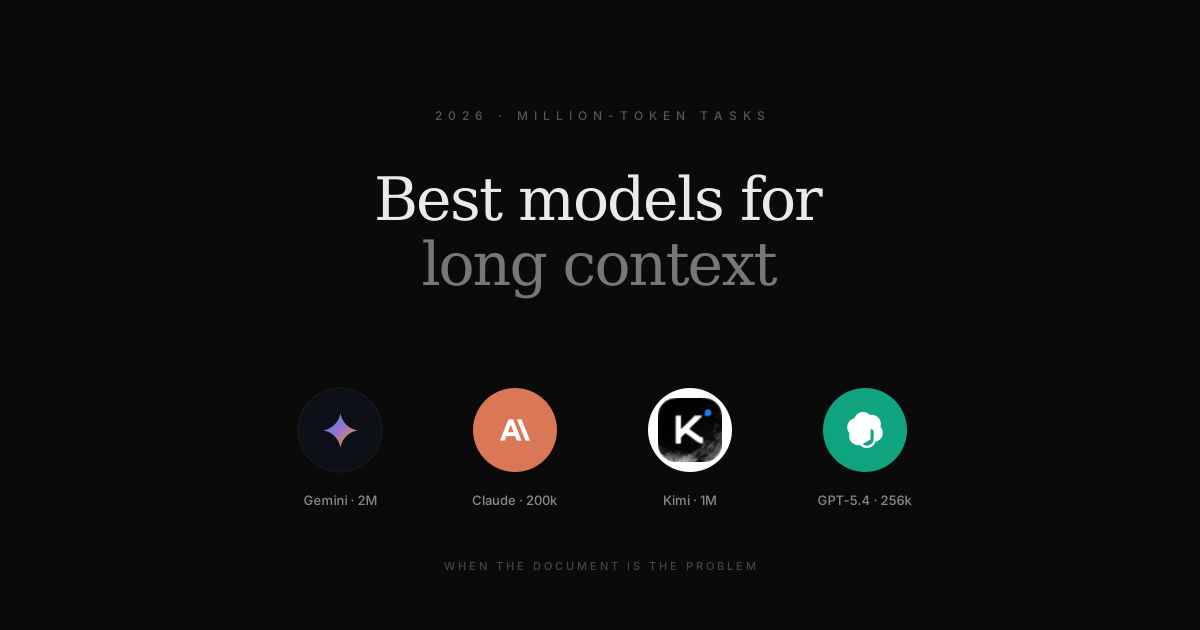
| Model | Advertised window | Effective recall | Price /M input |
|---|---|---|---|
| Kimi K2.6 | 256K | Stable to 256K | $0.60 |
| Kimi K2.5 | 1M | Solid to ~800K | $0.30 |
| Claude Opus 4.7 | 200K | Strong to 200K | ~$5 |
| GPT-5.4 xhigh | 256K | Degrades past ~180K | $1.25 |
| Gemini 3.1 Pro | 2M | True 2M | varies |
That's the short answer. The rest explains the K2.5→K2.6 trade, what 256K actually fits, and when you still need Gemini.
The number everyone gets wrong
Search "Kimi context window" and half the results say 1M. They're describing Kimi K2.5 — Moonshot's cheap long-document model. The newer K2.6, released April 20, 2026, is a different model with a different goal: the best open-weight autonomous coding agent, not the cheapest long-doc reader. K2.6's window is 256K tokens. (Full breakdown in our Kimi K2.6 review.)
Why Moonshot made the window smaller
Counterintuitive, but deliberate. Most 1-trillion-parameter MoE models advertise huge windows and quietly fall apart past ~100K tokens — the model "sees" the context but stops reasoning over it reliably. K2.5 itself only held solid recall to roughly 800K of its 1M.
K2.6 reformulates attention with sink optimizations so accuracy stays flat across the full 256K. For an agent reading a codebase, planning thousands of steps, and coordinating hundreds of sub-agents, stable 256K beats flaky 1M every time. The window you can trust is the window that counts.
What 256K tokens actually fits
Rough, practical conversions:
- ~256K tokens ≈ 190,000 words ≈ a 600–700 page book
- A medium codebase slice: ~25–40 source files with room for the agent's working memory
- A full research session: 15–20 long articles plus notes and a draft
- Months of an agent thread, with session summarization
For the overwhelming majority of agentic coding and research work, 256K is not the bottleneck — model quality is.
When 256K is not enough
Be honest about the ceiling. You still need a true long-context model when:
- You're feeding a whole monorepo or a 1,500-page PDF in one shot
- You need reasoning over 500K+ tokens end-to-end (actual synthesis, not retrieval)
- You're doing book-length document QA without chunking
For those, Gemini 3.1 Pro's 2M window is still the only model that works end-to-end — see our best long-context models in 2026. Kimi K2.5 ($0.30/M) is the budget option when you need raw window over reasoning depth.
Long context vs RAG (the part nobody likes)
Even at 256K, the question isn't only "does it fit" — it's "should you". Stuffing 256K tokens into every call is slow and expensive. For large, mostly-static corpora, retrieval (RAG) over a small context is cheaper and often more accurate. Rule of thumb:
- under 100K tokens → just feed it, any model
- 100K–256K → K2.6 long context is great
- 256K–1M → K2.5 or Gemini long context
- 1M+ → Gemini with summarization, or RAG
How Klaws handles it
Klaws routes by task. Agentic coding and tool-heavy work go to models like K2.6 where stable mid-size context plus reasoning wins. When an input crosses ~100K tokens of pure document, routing shifts to Gemini 3.1 Pro automatically — you don't pick windows, the router does. (More in how we switch models without rebuilding the agent.)
Bottom line
Kimi K2.6's context window is 256K tokens, and it works across all of it — which makes it more useful than K2.5's flaky 1M for real agent workloads. If your task genuinely needs 500K+ tokens of synthesis, reach for Gemini. For everything else, 256K of trustworthy context is plenty.