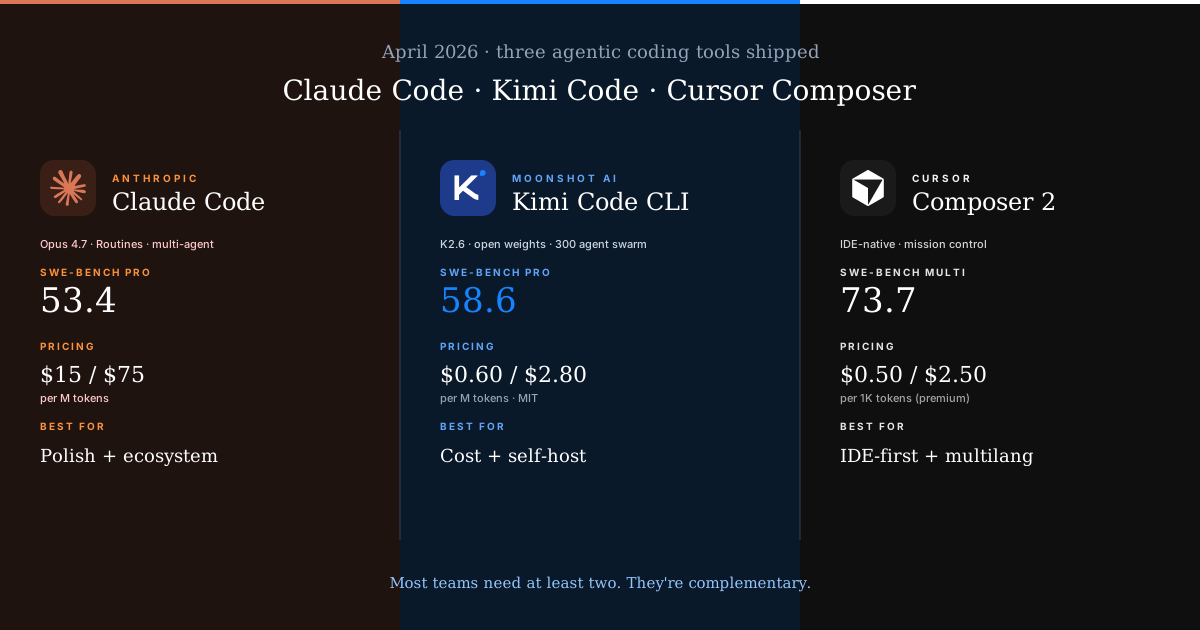
Three agentic coding tools took major leaps in April 2026: Claude Code shipped Opus 4.7 + Routines + multi-agent + Code Review, Moonshot dropped Kimi K2.6 with the Kimi Code CLI, and Cursor launched Composer 2. If you're choosing which one to standardize on, here's the head-to-head.
At a glance
| Claude Code | Kimi Code CLI | Cursor Composer 2 | |
|---|---|---|---|
| Vendor | Anthropic | Moonshot AI | Cursor |
| Surface | Terminal, desktop app, VS Code | Terminal + Hugging Face | Cursor IDE |
| Model | Claude Opus 4.7 | Kimi K2.6 (1T params, MIT) | Composer 2 (proprietary) |
| SWE-Bench Pro | 53.4 (max effort) | 58.6 | Not published |
| Terminal-Bench 2.0 | Not published | Not published | 61.7 |
| SWE-bench Multilingual | Not published | Not published | 73.7 |
| Open weights | No | Yes (Modified MIT) | No |
| Pricing | $15/$75 per M (API) | $0.60/$2.80 per M | $0.50/$2.50 per 1K tokens |
| Best for | Polished UX, ecosystem | Open-weight, cost, swarm agents | IDE-native, Cursor users |
Claude Code (Opus 4.7)
Strengths from April 2026 updates: Desktop redesign with sidebar for parallel agents, drag-and-drop session rearranging, integrated file editor and terminal. Routines — configure a session once, run on schedule / API / event trigger. Code Review — agent-based PR review with multiple AI reviewers analyzing changes.
Claude Code is the most polished of the three. The docs are great. The desktop experience is the one Anthropic poured the most design into. Opus 4.7 itself has "stronger software engineering, better vision, sharper instruction following, more reliable long-running agent work" per the release notes.
Weakness: it's the most expensive. $15/M input, $75/M output. A serious daily developer workflow on Opus 4.7 regularly hits $200-400/month in API spend. Also closed-source — no self-host, no fine-tune, no air-gapped deploy.
Kimi Code CLI (K2.6)
Moonshot's release of K2.6 came with the Kimi Code CLI — a Claude-Code-style terminal runner that uses K2.6 as its backing model. Notably:
- SWE-Bench Pro 58.6 — the highest verified score of the three (beats Claude Opus 4.6 max-effort at 53.4, and exceeds GPT-5.4 xhigh at 57.7)
- Sub-agent swarm: up to 300 parallel sub-agents, 4,000 coordinated steps — 3x K2.5's capacity
- Open weights under Modified MIT on Hugging Face — self-hostable (if you have the 8× H100 NVL needed for 1T MoE)
- Pricing on OpenRouter: $0.60 per million input, $2.80 per million output — ~12x cheaper than Claude Opus 4.7
Weakness: the CLI is newer and rougher than Claude Code. Docs are thinner. Desktop/IDE integration isn't at Anthropic's polish level. You trade polish for capability and cost.
Cursor Composer 2
Launched March 19, 2026. Built into the Cursor IDE as an agent-first development experience.
Key specs from Cursor's launch post:
- CursorBench 61.3, Terminal-Bench 2.0 61.7, SWE-bench Multilingual 73.7 — multilingual code lead
- Three-phase agent workflow: explore → plan → execute with approval gates
- Persistent context across sessions (not just current file — full history of decisions and constraints)
- "Mission control" — manage parallel code changes across a codebase without conflicts
- Fast variant: 3x throughput, 5x price
Pricing: $0.50 per 1K input tokens, $2.50 per 1K output ($500/M input, $2500/M output) — pricing structure is per thousand not per million, which signals premium positioning.
Strength: IDE-native UX is the tightest of the three. If you live in Cursor already, Composer 2 is the path of least resistance. The multilingual SWE-Bench lead (73.7) is genuine — best in class for non-English codebases.
Weakness: locked to Cursor IDE. If you're not a Cursor user the switching cost is high. Per-1K pricing is unusual and, at scale, competitive only if you're in the Cursor subscription already (Pro tier includes a meaningful compute allowance).
Head-to-head by use case
Refactor a large monorepo:
- Kimi Code CLI — 300 sub-agent capacity + 4,000-step horizon is purpose-built for this. Cheaper too.
Daily PR reviews on a team:
- Claude Code — the new Code Review feature with multiple AI reviewers is the most polished PR workflow available.
Working inside an existing Cursor project:
- Composer 2 — IDE-native beats external CLI for tight in-flow editing.
Multilingual / non-English codebase:
- Composer 2 — 73.7 SWE-bench Multilingual is genuinely best in class.
Self-host / air-gapped / compliance:
- Kimi Code CLI — only one of the three with open weights.
Enterprise with Anthropic-heavy stack:
- Claude Code — ecosystem fit, MCP integrations, Console billing, the Routines cron model.
Indie dev minimizing monthly API spend:
- Kimi Code CLI — 10-12x cheaper than Claude Code for comparable agent-coding performance.
The meta-question: do you need an agentic coding tool at all?
If you're a developer and your work product is code, yes — pick one of these three. But if your work is building a product (not writing code directly) or operating a business (research, outreach, content, monitoring), agentic coding tools are the wrong abstraction.
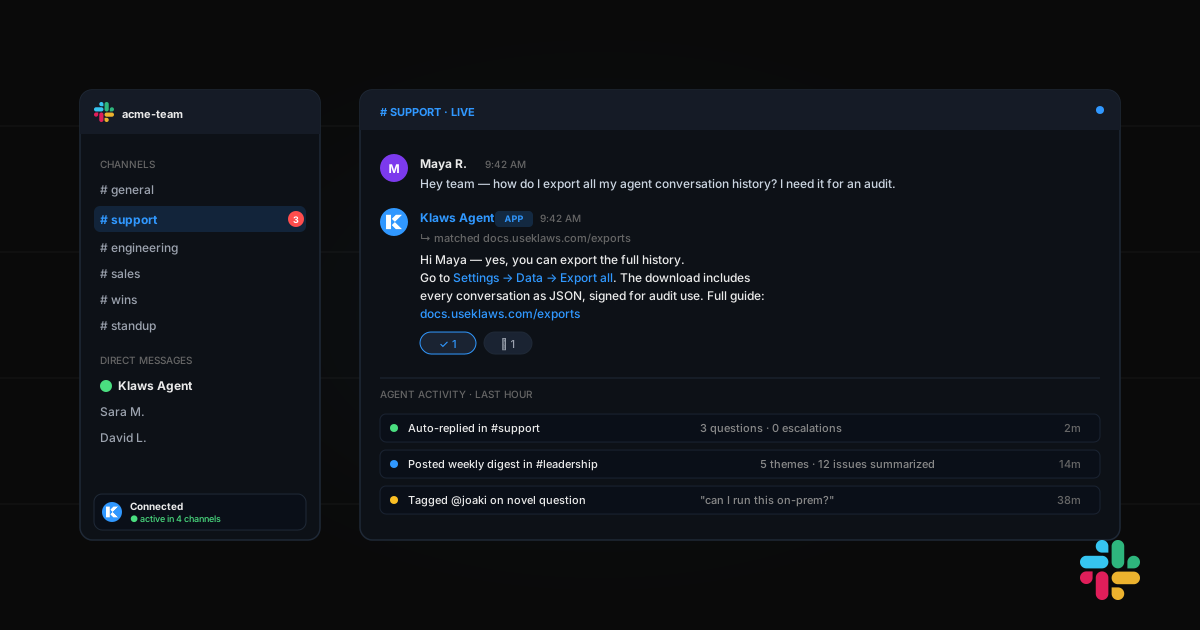
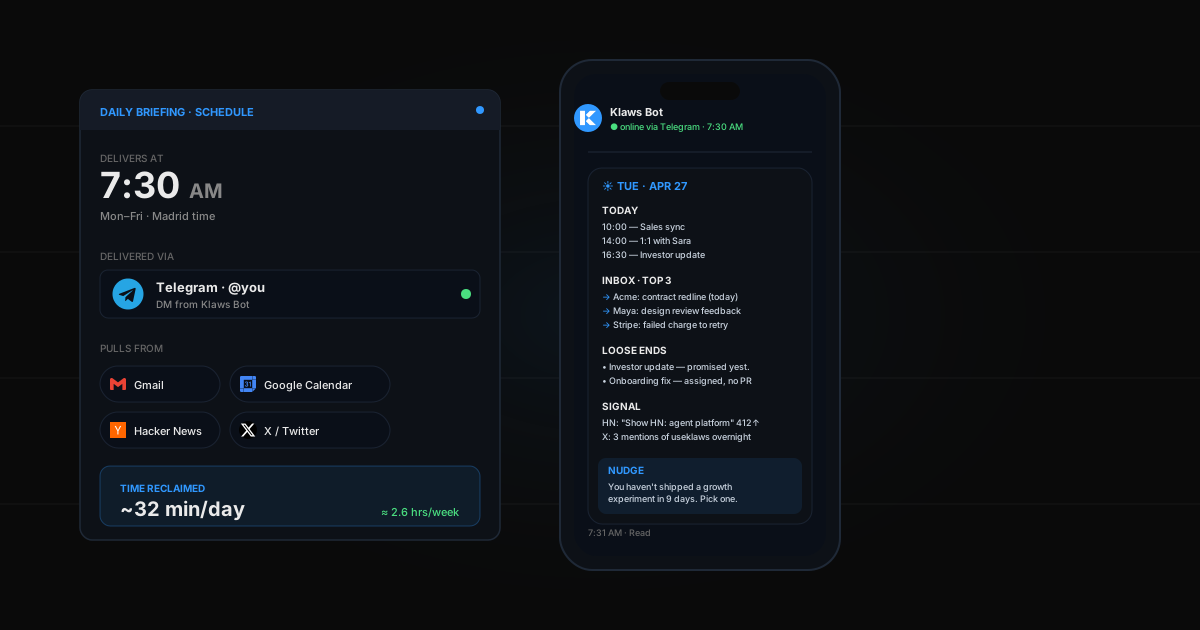
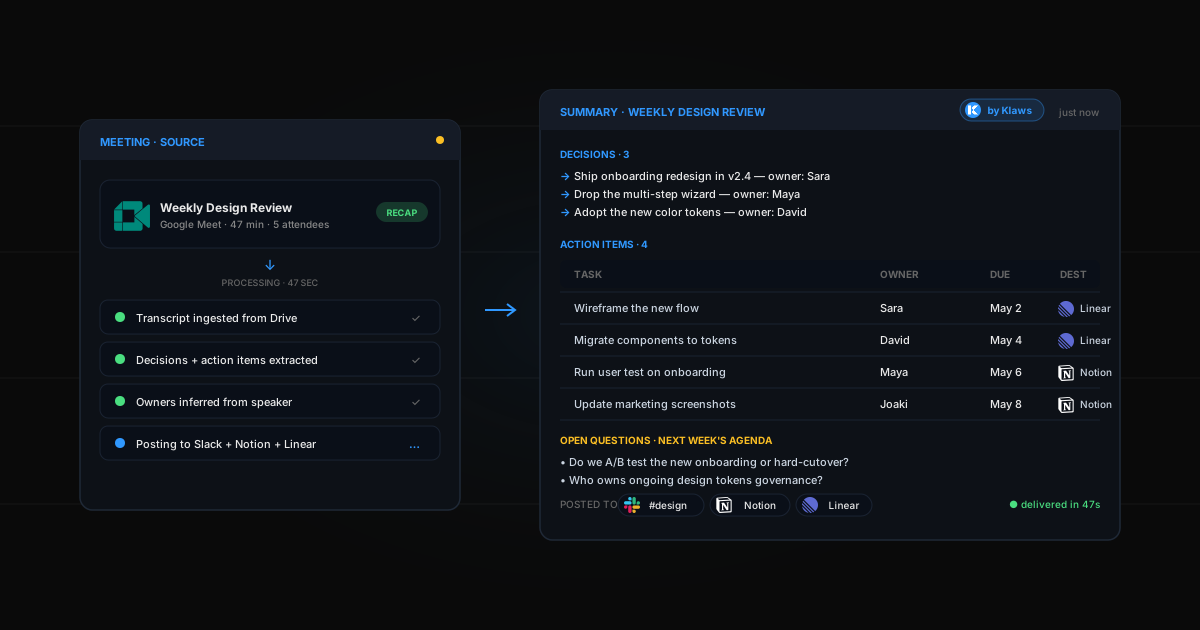
That's the gap Klaws fills. A personal AI agent that handles everything outside the IDE: scheduled research, email triage, content repurposing, competitor monitoring, CRM updates. It routes coding sub-tasks to Kimi K2.6 under the hood when needed, but doesn't expect you to live in a terminal. See our full comparison to Claude Code for the deeper framing.
Bottom line
- Polish and ecosystem → Claude Code
- Open weights, cost, swarm → Kimi Code CLI
- IDE-native + multilingual → Cursor Composer 2
- Not-a-coder → Klaws
Most serious teams will use at least two of the first three — Cursor Composer during live IDE work, Claude Code for background Routines, and Kimi Code CLI for batch refactors. They're complementary more than competitive.
Try Klaws for 3 days free → if you want the non-developer version. For model-level deep reads, see Kimi K2.6 and Qwen 3.6 Max.