Every content creator hit the same wall in 2024: AI tools generate content fast, but the output looks like AI. Google penalizes it. Readers skip it. Nothing converts.
The fix isn't "use better AI." It's using AI strategically — as a research and drafting tool inside a workflow that still involves human judgment and expertise.
The old workflow (broken)
- Copy topic into ChatGPT
- Ask for a blog post
- Paste output
- Post
Result: generic, obvious AI writing. 300 impressions. No engagement.
The new workflow (works)
- Research phase — your AI agent gathers sources
- Outline phase — you approve structure before drafting
- Drafting phase — AI writes sections based on research
- Editing phase — you add your voice and expertise
- Repurposing phase — one piece → multiple formats
- Distribution phase — scheduled across channels
Step-by-step breakdown
Step 1: Research (10 minutes)
Give your agent a topic and target keyword:
"Research the current state of remote work productivity tools in 2026. Find 10 authoritative sources, pull key statistics, and identify trending pain points discussed on Reddit and Hacker News."
Your agent comes back with citations, stats, and real user complaints. This is your evidence base.
Step 2: Outline (5 minutes, you approve)
"Based on that research, outline a 1,500-word blog post targeting the keyword 'best remote work tools 2026'. Structure: hook, problem, 5 tool categories with 2 picks each, comparison table, FAQ."
Your agent drafts the outline. You edit it — what to emphasize, what to cut, what order makes sense. This is where your strategy lives.
Step 3: Draft (10 minutes)
"Write the first draft. Use the research findings for evidence. Match the tone of my previous posts at [your-site.com/blog]. Include internal links to [pages]. Keep paragraphs short."
Your agent drafts each section with citations. The writing isn't perfect, but it's grounded in real sources — not hallucinated facts.
Step 4: Edit (15-30 minutes, you)
This is the human part. You:
- Add your personal experience and opinion
- Rewrite the intro to sound like you
- Delete fluff
- Tighten transitions
- Add concrete examples from your work
- Fix factual errors (always)
The result is your voice, backed by your agent's research.
Step 5: Repurpose (5 minutes)
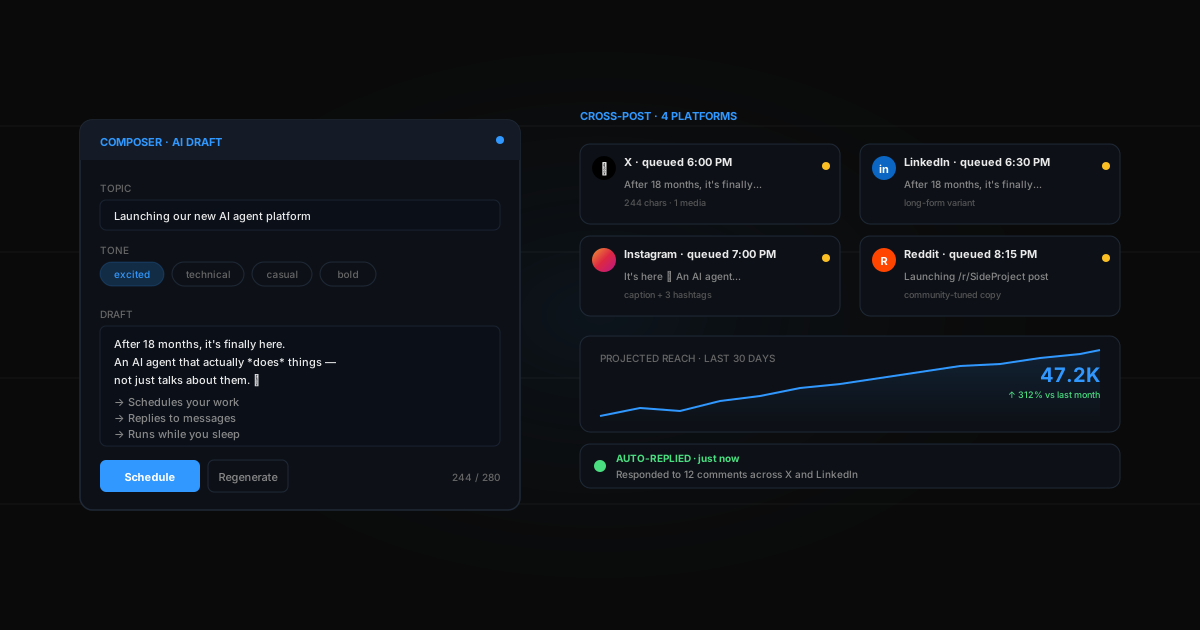
"Turn this blog post into: a 7-tweet X thread, a LinkedIn post, a newsletter segment, and 3 quote images for Instagram."
Your agent creates all formats, adapted to each platform's tone. You review and approve.
Step 6: Distribute (2 minutes)
"Schedule the blog post for Monday 9am. The X thread for Tuesday 8am. The LinkedIn post for Wednesday 10am. The newsletter for Thursday 6am."
Your agent schedules everything across integrated channels. Done.
Total time
- Research: 10 min
- Outline: 5 min
- Draft: 10 min (async)
- Edit: 20 min (you)
- Repurpose: 5 min (async)
- Distribute: 2 min
- Total: ~50 min for a fully researched, multi-format content package
The old way (manual): 4-6 hours. The "raw AI" way: 10 minutes for content that gets 0 traction.
Why this works
Google's algorithm rewards:
- Original insight (you add this)
- Real sources (your agent provides these)
- Depth (the research supports it)
- Author expertise (your voice shows this)
Raw AI content fails on 1 and 4. Manual content fails on 2 (slow) and 3 (you skim, AI doesn't). The hybrid workflow hits all four.
The key insight
AI is a research intern and a drafting assistant. It is not a content creator. You are still the creator. Your judgment, your voice, your experience — those are irreplaceable.
Use AI to do the boring parts faster, not to replace the thinking parts entirely. For the social distribution side, see our guide on automating social media with AI.
Real results
With this workflow, small teams are publishing:
- 3-5 long-form posts per week (vs. 1 before)
- 20+ social posts (all formats)
- Weekly newsletters
- While the quality goes up, not down
Because they're spending their time on the strategic parts — research direction, voice, expertise — and letting the agent handle the grunt work.